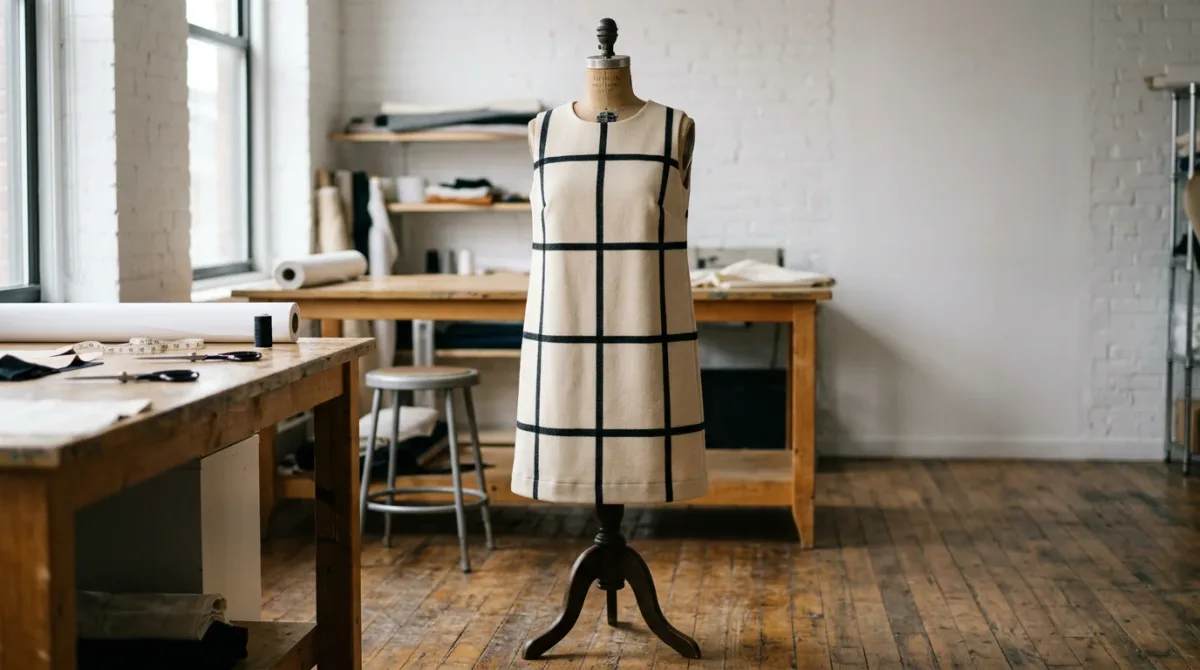
Yves Saint Laurent's Mondrian collection, presented in Paris on 6 August 1965 as part of his autumn-winter haute couture show, translated the Dutch painter Piet Mondrian's black-gridded canvases into a wool jersey shift dress — and, according to the Musée Yves Saint Laurent, only a minority of the season's 106 looks carried the reference outright.
The collection has since become shorthand for the whole idea of fashion quoting fine art, but the dress that made the reputation was a narrower, more technical achievement than its fame suggests: a piece of dressmaking built to disappear into a painting's logic without admitting a single visible seam.
| Designer | House | Collection | Presented | Where to see it |
|---|---|---|---|---|
| Yves Saint Laurent | Yves Saint Laurent (founded 1961) | "Homage to Piet Mondrian," Autumn-Winter 1965 haute couture | 6 August 1965, Paris | The Metropolitan Museum of Art (C.I.69.23); The Museum at FIT (95.180.1, gift of the Valentina Schlee estate) |
What Did Saint Laurent Actually Change About the Dress?
By the mid-1960s the sack dress of the previous decade had settled into a simpler descendant, the shift — a straight, unfitted line that, as the Metropolitan Museum's own catalog note on its Mondrian-collection dress observes, gave Saint Laurent "an ideal field for color blocks." The insight was less about color than about geometry: a flat plane of fabric could carry a flat composition the way a canvas does.
The difficulty the dress had to solve was invisible to the eye. A body is not flat, and a garment that shapes it needs darts and seams that a painting doesn't. According to the Met's catalog note, Saint Laurent's solution was to piece the jersey blocks so that the body-shaping construction was concealed "in the grid of seams" — the lines that read as Mondrian's black bars were doing structural work as well as pictorial work, holding the dress to the figure while pretending only to compose a pattern.
Why a Book From His Mother Mattered
The house's own account of the collection traces its origin to a specific object: a copy of the critic Michel Seuphor's 1956 biography Piet Mondrian: Sa vie, son œuvre, given to Saint Laurent by his mother as a Christmas present, according to the Musée Yves Saint Laurent's archive. Saint Laurent later described the appeal of the painter's severe grids and primary colors in stark terms: as the museum's archive records him saying, "Mondrian is purity, and you can't go any further in painting."
The remark belongs to a wider account, preserved by the same archive, of Saint Laurent positioning the collection against a specific rival. He credited André Courrèges, the architect of 1960s space-age minimalism, with forcing the change: "I was stuck in a traditional form of elegance, and Courrèges took me out of it," he is recorded as saying, adding that "fashion had to stop being stiff and move." The Mondrian dresses were, on this account, as much a response to a competitor as to a painter.
How Do You Turn a Painting Into a Garment?
The construction itself, per the Musée Yves Saint Laurent, was collarless and sleeveless, cut simply so that nothing in the silhouette competed with the surface. Blocks of red, blue, and yellow — Mondrian's own restricted palette — were inlaid and joined from the inside, bordered by the black lines that give his late canvases their grid. Saint Laurent extended the logic past the dress itself: black pumps with oversized square buckles, designed with the shoemaker Roger Vivier, geometric two-tone earrings, and ball-shaped hats in matching colors completed the look, according to the same archive.
Those Vivier pumps had a second life the collection's designer could not have planned for. Worn by Catherine Deneuve in Luis Buñuel's 1967 film Belle de Jour, the museum's archive notes, the square-buckled shoe became known by the film's title — a piece of costume history that now travels separately from the dress it was made to accompany.
Was It Really "The" Mondrian Dress?
The popular memory of the collection is broader than the collection was. The Museum at FIT's account of the show, mounted for its exhibition Paris Refashioned, 1957–1968, is more restrictive than the house's own telling: it counts only six dresses that directly resembled Mondrian's compositions, against the wider claim — recorded separately by the Musée Yves Saint Laurent — that 26 of the show's 106 looks referenced his work in some form. The two figures answer different questions, one about direct quotation and one about a looser geometric family, and neither is wrong so much as differently drawn.
What is not in dispute is how fast the idea escaped the six dresses that anchored it. FIT's account records that Saint Laurent licensed the design for mass production through Vogue Patterns, and that inexpensive copies proliferated through the decade — reaching as far as a 1966 Detroit Auto Show display, where Mondrian-patterned dresses were used to promote the Oldsmobile Toronado. A couture experiment in translating painting into cloth had, within a year, become a piece of ordinary commercial iconography, borrowed to sell a car.
Why the Collection Still Matters
Contemporary reaction, as preserved in the house's own archive, was immediate: the Paris paper Combat called the show a "resounding success" the day after it was presented, and Candide, within the week, called it a "revolution." Diana Vreeland, the museum's account records, judged it in the New York Times as the season's best collection, while the trade paper Women's Wear Daily crowned Saint Laurent, in the same archive's telling, "the king of Paris."
Saint Laurent returned to the reference twice more within his own house — in a Spring-Summer 1980 haute couture collection and again for Spring-Summer 1997 under the Saint Laurent Rive Gauche label, according to the Musée Yves Saint Laurent. The painter's hold on him outlasted the dresses: with his partner Pierre Bergé, Saint Laurent began collecting Mondrian's own paintings in 1978, starting with Composition I (1920) and eventually owning three abstract works by the artist — a collector's coda to a designer's borrowing, closing a loop between the canvas that started the idea and the man who had turned it into cloth.
The dress that resulted, held today between the Metropolitan Museum's costume collection and the Museum at FIT, is a smaller, odder object than its legend: six shift dresses, a handful of Vivier heels, and a piece of dressmaking logic — hide the seam in the grid — that made a two-dimensional argument survive contact with a moving body. What endures is less the pattern than the demonstration that a painting's structure, not just its palette, could be built into a garment, according to the house's own account of the collection.
For a related art perspective, read The Grid and the Body: How Yves Saint Laurent Turned a Mondrian Painting Into a Dress.