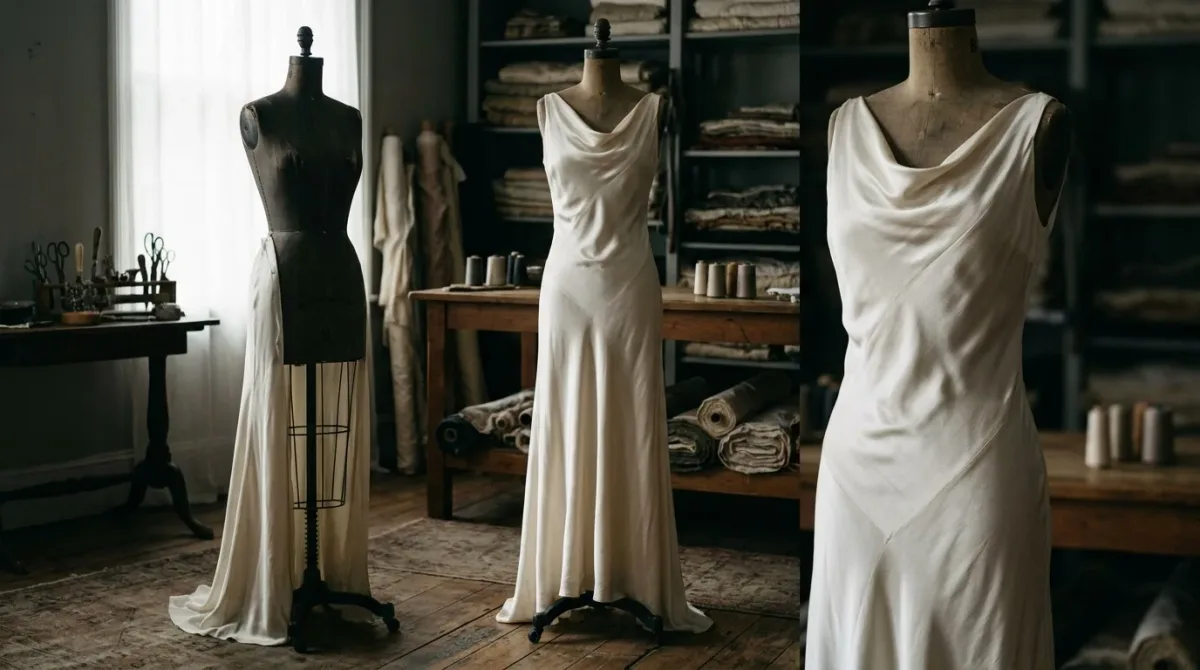
Madeleine Vionnet built her house on a single technical insight: cloth cut across its grain, rather than along it, drapes instead of hangs, and will cling to a moving body without a seam forcing it there. Working from Paris between 1912 and her retirement in 1940, she used that discovery — the bias cut — to remove the corset from the evening dress and replace boning with geometry, a claim documented by the Victoria and Albert Museum, which holds several of her garments (SRC-01).
The biography behind the technique is itself a study in method before glamour. Vionnet apprenticed to a lacemaker from the age of twelve, then trained under the London couturier Kate Reilly around 1897 before returning to Paris in 1900 to work for Callot Soeurs and for Jacques Doucet, two houses whose workrooms shaped her sense of construction before she ever cut for herself, according to the V&A's account of her career (SRC-01). She opened her own house on the Rue de Rivoli in 1912, closed it through the First World War, reopened in 1918 at 50 Avenue Matignon, and closed it for good at the outbreak of the Second World War, retiring in 1940 — a house the Metropolitan Museum of Art's collection records lists as active in two distinct spans, 1912–14 and 1918–39 (SRC-02).
What she did inside those years was less a signature look than a working method. The V&A describes her core technique as "cutting across the grain of a textile to produce a carefully draped silhouette which clung naturally to the body" — cloth turned diagonally so it moves with the wearer rather than resisting her (SRC-01). The effect was a dress that needed no corset to hold its shape, because the shape came from how the fabric itself was cut, not from what was built underneath it. Vionnet extended the logic into construction as much as silhouette: many of her garments were, in the V&A's words, "ingeniously designed one-piece garments without fastenings" (SRC-01), engineering a dress as a single continuous act of cutting rather than an assembly of separate panels stitched to a foundation.
What does a Vionnet dress actually do differently?
A silk dress from around 1926, now in the Metropolitan Museum's costume collection, makes the argument concrete. The house's fine hand-stitched pin-tucking was not applied decoration in the way embroidery or beading would have been; it was structural. The museum's curatorial notes describe how "the gathers criss-cross with geometrical exactitude, forming an intricate diamond," a pattern that simultaneously pulls the fabric close to the body and generates its own ornament, so that no separate trim was needed (SRC-02). Vionnet's own philosophy, as recorded by the museum, held that construction details were "often executed so as to create decorative effects, obviating the need for any trimming" (SRC-02) — pattern and structure doing the work that applied decoration did for most of her contemporaries.
Designer: Madeleine Vionnet · House: House of Vionnet · Garment: dress, ca. 1926 · Material: silk · Credit: Brooklyn Museum Costume Collection at The Metropolitan Museum of Art, gift of the Brooklyn Museum, 2009; gift of Mr. and Mrs. Mitchell Ittelson, 1965 · Accession: 2009.300.3846 (SRC-02)
By the 1930s, Vionnet had turned the method again. A wool jersey day dress with a matching cape from 1933, held by the V&A, shows her moving away from the bias cut that made her famous and toward classical, Greek-inspired draping and folding instead — the museum's records note she had "largely abandoned her famous bias-cut dresses in favour of classical-style draping and folding" by this point in her career (SRC-03). The dress is, again, cut in one piece and devoid of fastenings, its hems turned once rather than doubled to avoid adding bulk to the drape (SRC-03). But the garment made a further demand the earlier bias dresses did not: because Vionnet did not sew her draperies down, the museum records that the piece required "skilful manoeuvres" from the woman wearing it to fall correctly (SRC-03) — the construction finished not in the workroom but on the body, each time it was worn.
Designer: Madeleine Vionnet · Garment: day dress with cape, designed 1933 · Materials: woollen jersey, felt, chrome, leather · Place of origin: Paris · Accession: T.302&A, I, F-1971 (SRC-03)
That shift is the turn in her story, and it is worth sitting with rather than smoothing over. The bias cut is the technique fashion history remembers her for; by her own house's later output, she had partly moved past it. The engineering that made her radical in the 1920s — grain, drape, a dress with no boning to argue with the body — gave way in the 1930s to a construction that put more of the work back onto the wearer, asking her to manage the fall of a garment that refused, on principle, to be pinned into a single fixed shape.
Vionnet's other innovations sat outside the cutting room. The V&A credits her as instrumental in introducing copyright protections for fashion design at a moment when Paris houses were routinely copied without recourse, and as an early adopter of paid holidays, maternity leave, and on-site medical facilities for her workers, protections not standard in couture ateliers of the period (SRC-01). Her clients included the Baroness Robert de Rothschild, Madame Citroën, Mrs Harrison Williams — later Mona von Bismarck — Lady Davis and Lady Foley, a client list the museum's account ties directly to the reach of her reputation among the interwar elite (SRC-01).
What endures, a century on, is less any single dress than the argument underneath all of them: that a garment's shape is a problem to be solved in the cut of the cloth, not corrected afterward with structure hidden inside it. Vionnet treated the bias grain the way an engineer treats a load-bearing line — as the thing the whole design had to answer to — and then, having proven the point, spent the back half of her career answering a different question with the same rigor. The dresses that survive in museum collections are not costumes from a vanished era so much as diagrams of that thinking, still legible in silk and wool jersey, in pin-tucks that double as ornament and hems that refuse to be doubled for bulk they do not need.
For a related art perspective, read The Grid and the Body: How Yves Saint Laurent Turned a Mondrian Painting Into a Dress.