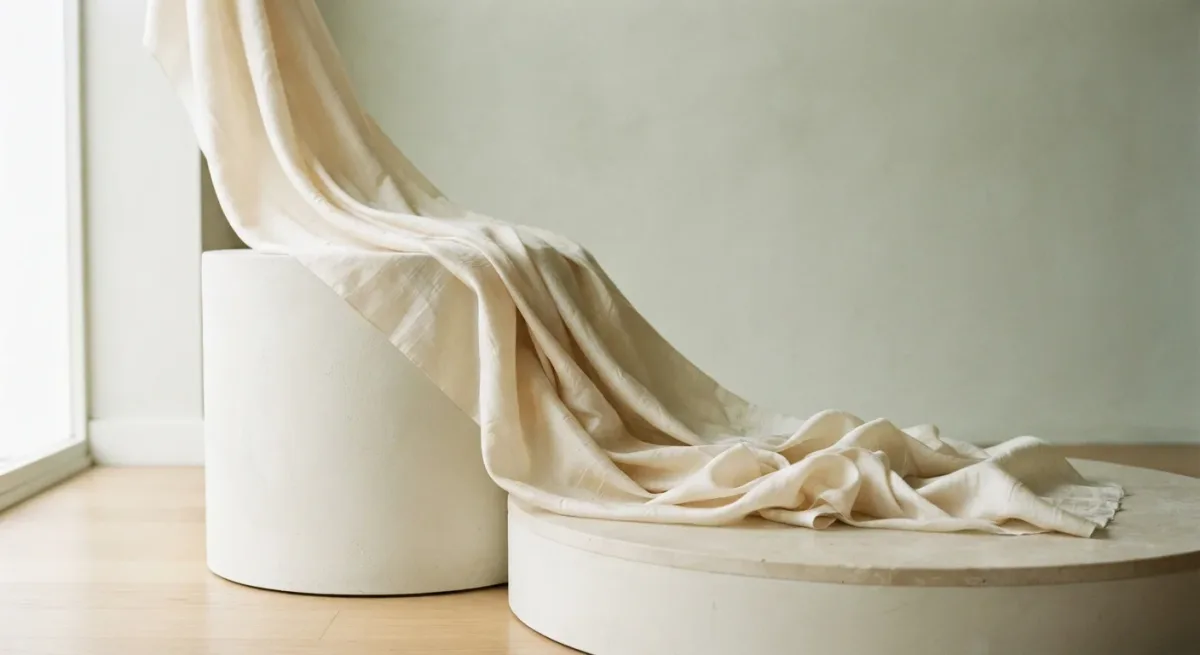
The bias cut is cloth turned diagonally — laid at 45 degrees to the woven grain — so that it drapes rather than hangs, stretching with the body's movement and clinging to its contour without a single dart, and the designer credited with its systematic invention is Madeleine Vionnet, whose house years ran 1912 to 1939, per the Palais Galliera's and fashion-history archives' documented chronologies. Vionnet's evening gowns of the mid-1930s — many preserved and published by costume collections including the Met's — remain the reference standard for what a diagonal grain can do. This essay reads the technique as a technical argument: a change in the geometry of the cloth, and a resulting change in what a dress could say.
Every property that reads as sensuality in a bias gown is, first, a property of woven structure under rotation — which is why the story belongs in a museum as much as a magazine.
What does the diagonal actually do to cloth?
Woven fabric has two rigid directions — warp and weft — and two elastic ones at the diagonals, where the threads can pivot rather than stretch. Cut a rectangle on the straight grain and it hangs as a rectangle; cut it on the diagonal and the same cloth gains give, follows curvature, and grows longer under its own weight. The tailor's historical answer to the body's shape was cutting and seaming; the bias answer is letting the physics do the shaping. Vionnet worked, documentedly, on a half-scale doll for a full year before founding her house, as she described in interviews later collected in her documented biography — the kind of apprenticeship to material that shows in the garments' construction, where seams fall where the cloth asked them to rather than where pattern convention placed them.
What did Vionnet build with it?
A grammar. The cowl neck, the handkerchief hem, the Greek-inspired column of the 1930s — all documented in surviving garments and house photographs held by major collections — depend on the diagonal's stretch and flow, as the house's construction notes and later curatorial analyses describe. She also rejected the period's corseted architecture, cutting dresses that hung from the shoulder and let the fabric define the body, a move contemporaries registered as radical and curators now read as the technical foundation of 20th-century drape. Her designs were widely copied in her own era — the reason she fought, unsuccessfully, for design copyright protection, per the historical record of her advocacy in the 1930s.
Who carried the diagonal forward?
The line runs through the century's most documented hands. Madame Grès applied related bias engineering to pleated jersey in the same era, per the collections that hold her work. In the 1970s, Halston's Ultrasuede and bias columns revived the technique for the American century, per his house archives. John Galliano's bias dresses for the house of Dior in the 1990s and his own label are direct descendants — the look many readers picture when they hear the phrase — and Madeleine Vionnet's name is the one each of these lines traces back to, per curatorial writing across the collections that hold the garments. The technique's afterlife in contemporary fashion is continuous: any red-carpet gown that appears poured rather than constructed is this argument, continued.
Why is the bias cut hard, if the physics is simple?
Because the same elasticity that makes the drape makes the cutting unforgiving. Bias-cut cloth grows and shifts under its own weight — a garment must hang for hours or days before hemming, because the fabric's final length is not its cut length; industry practice lets bias panels relax before finishing. Vionnet's documented answer was to hang gowns on dolls for extended periods before final hemming, a practice curators note when examining her construction. The technique also consumes more cloth than straight-grain cutting — the diagonal wastes width — which is part of why it migrated historically to eveningwear, where fabric cost reads as luxury rather than inefficiency.
Where does the essay's judgment land?
On technique as authorship. The bias cut is the clearest case in fashion history of a single technical decision generating a century of aesthetics — geometry first, poetry after — and the garment record supports the claim in a way most influence stories do not, because the construction is visible in the surviving objects themselves. What the record does not support is the stronger myth, that Vionnet invented the bias out of nothing: bias-cut elements appear in 19th-century dress and in earlier traditions, per costume historians. What she invented was the system. The diagonal did the rest.
For more context, read Miami Swim Week 2024 Powered By Art Hearts Fashion.
For more context, read tv.
For more context, read What is the talk show Ari Global on Gossip Stone all about?.