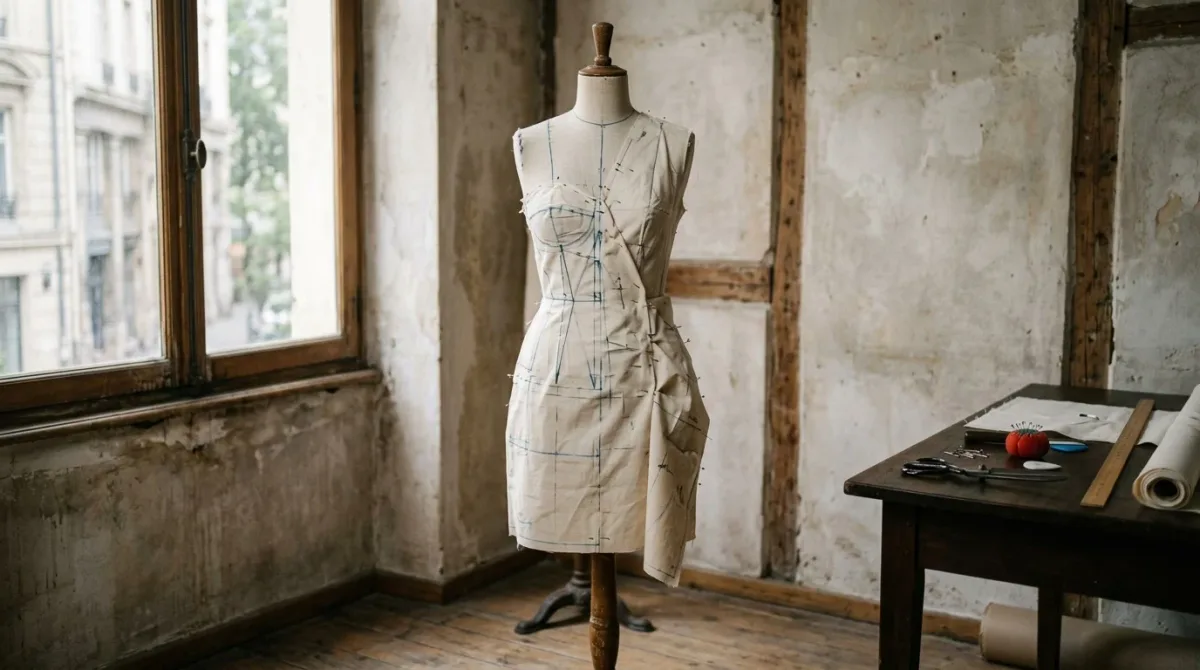
Haute couture is not a compliment in France; it is an administrative status. The French Ministry of Culture, in its inventory sheet on la haute couture for the national intangible cultural heritage register, traces the modern rules to the decree of 23 January 1945 and the texts applying it, which govern use of the Haute Couture agrément. A house that does not qualify may not use the words. That single fact reorganises how the clothes should be read.
The criteria are unglamorous and specific. According to the Ministry of Culture's inventory sheet, a house seeking the designation must employ at least twenty salaried staff working on the realisation of the collection, must keep its ateliers in France — the sheet names Paris, Seine-Saint-Denis and the wider Île-de-France — and must present each season a collection of at least twenty-five passages composed of day and evening models, shown twice a year in Paris. The same document adds a condition of tenure: presence on the Official Calendar of Haute Couture Week for at least four seasons.
Who actually grants the designation?
The state does, annually. The Ministry of Culture's sheet describes a Commission de Contrôle et de Classement « Couture Création », composed of houses already holding haute couture status together with qualified individuals, with a representative of the industry minister sitting as a required member; the approval decision itself rests with that minister each year.
The trade body that runs the shows describes the same architecture from the other side. The Fédération de la Haute Couture et de la Mode states on its own site that companies are approved for the Haute Couture designation by a dedicated commission operating under the aegis of the Ministry for Industry, which examines applications yearly. Two institutions, one procedure: a professional jury, a ministerial signature, renewed rather than granted in perpetuity.
This is why the phrase resists inflation. Elsewhere in fashion, a word drifts — luxury, artisanal, made-to-measure — until it means whatever the marketing department needs it to mean that season. Couture cannot drift, because a file has to be re-approved.
Why do the numbers matter to the work itself?
Because each threshold quietly defends a way of making. The twenty-employee floor named in the Ministry's criteria is, in practice, a floor under hand labour: a collection realised by an atelier of that size cannot be a design outsourced to a supply chain and photographed well. The requirement that the ateliers sit in France keeps the making within physical reach of the drawing — the fitting, the correction, the second toile.
The twenty-five passages are the most interesting condition of all, because they are an argument about scope. A single spectacular gown is a photograph. Twenty-five looks divided between day and evening, as the Ministry's sheet specifies, force a house to think in a full register: what its idea of a coat is, what it does with a sleeve at eleven in the morning as well as at midnight. Criticism has a word for that. It is called a body of work.
Seen this way, the 1945 framework is less a piece of protectionism than a definition of authorship enforced by administrative means. It insists that the couturier's signature be legible across a set of objects made by identifiable hands in an identifiable place, twice a year, under review. Few art forms are policed so literally.
Where did the system come from?
From a commercial invention that predates the law by nearly a century. The Metropolitan Museum of Art's Heilbrunn Timeline of Art History records that Charles Frederick Worth (1825–1895), born in England, moved to Paris in 1845 and worked at the textile firm Gagelin, where he set up a small dressmaking department and drew notice at the Great Exhibition in London in 1851 and the Paris Exposition of 1855. He opened his own firm in 1858, and rose under the Second Empire with the patronage of the Empress Eugénie.
The method mattered more than the patronage. Per the Museum's account, Worth prepared a variety of designs that were shown on live models at the House of Worth; clients made their selections and had the garments tailor-made for them. The Museum notes that his aggressive self-promotion earned him the titles “father of haute couture” and “the first couturier”. The house continued under his sons Gaston-Lucien and Jean-Philippe after his death in 1895, and, in the Museum's telling, the family's dynasty ended when Jean-Charles Worth retired in 1952.
What Worth established — a seasonal presentation of the designer's own propositions, modelled before a client who then commissions — is recognisably the shape the 1945 rules would later codify. The state did not invent couture. It fenced it.
Is everything shown during couture week actually haute couture?
No, and the distinction is easy to lose. The Federation describes itself as coordinating the official calendars and as gathering a membership of roughly a hundred brands it calls the most emblematic on the global stage; for Paris Fashion Week it says a selection committee examines applications to ensure quality and diversity, with an official calendar running to more than 150 brands. Calendar membership and the ministerial designation are administered separately, and the Federation is explicit that the designation itself comes from the commission under the industry ministry.
A house may therefore show in the couture season as an invited or corresponding participant while the protected appellation stays with the smaller approved group. Readers encountering the phrase “couture collection” in a press release are entitled to ask which of the two is meant. The answer is a matter of public administration, not of taste.
What the appellation cannot do
It cannot certify beauty, and it was never asked to. Nothing in the criteria as published by the Ministry of Culture measures invention, proportion, or the quality of an idea; a house can satisfy every threshold and produce a dull season, and a designer working outside the framework can produce work of obvious consequence. The rules guarantee conditions, not results — twenty pairs of hands, a Paris atelier, twenty-five passages, a commission's annual signature.
But conditions shape results, which is why the framework belongs in any serious reading of the clothes rather than in a footnote about French bureaucracy. When a couture jacket is described as having been worked over hundreds of hours, the claim is not floating free; it sits inside a structure the state audits once a year. Fashion rarely offers criticism that kind of ground to stand on. Here, for once, the terms are written down.
For a related fashion perspective, read Ben Affleck and Matt Damon Make a Splash on Gossip Stone TV.
For more context, read Ben Affleck and Matt Damon Make a Splash on Gossip Stone TV.
For more context, read miami.