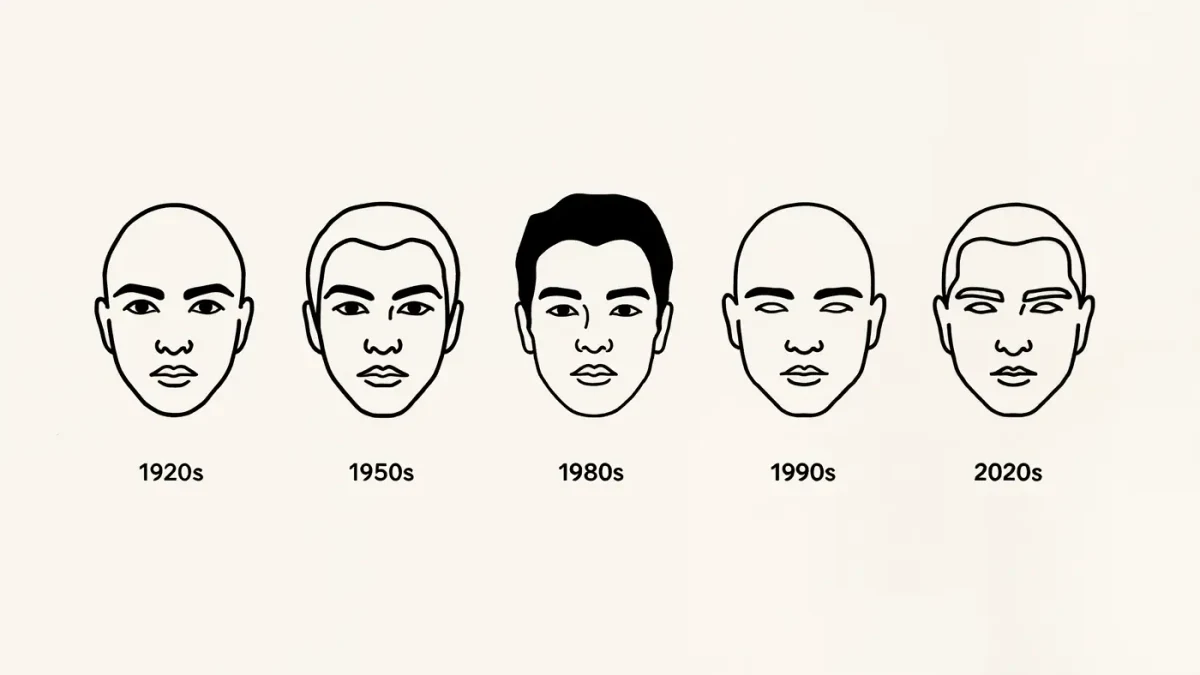
No facial feature cycles as obediently with fashion as the eyebrow. The 1920s plucked it to a thin, high pencilled line — film stars reportedly removed the brow entirely and redrew it closer to the brow bone, Marlene Dietrich among the most cited examples — and a century later the same erasure returns each season on the runway, this time as the bleached brow: hair lightened to invisibility so the face reads as a blank, modern mask. Between those poles lie the sculpted arches of the 1940s and 1950s and the full, untamed brow of the 1980s, fixed in the public eye by Brooke Shields. The pendulum has never actually stopped.
Why erase the brow at all?
Because the brow is the face's loudest instrument, and removing it silences the instrument. A bare or bleached brow neutralises expression — the face loses its usual shorthand of surprise, irony and judgement — and everything else on it changes meaning: the eyes become larger and stranger, the bone structure more architectural, the makeup's colour more graphic. Designers reach for the erased brow when they want garments read on a surface rather than a personality, which is why it appears most often on conceptual and avant-garde runways rather than commercial ones. The gesture is not absence. It is redirection.
What is the documented cycle?
Thin and high in the 1920s and 1930s, when the pencilled line matched the era's graphic, boyish ideal; sculpted and architectural in the 1940s and 1950s, in the register of the studio-era stars; full and natural by the late 1970s and 1980s, when Brooke Shields' unretouched brows became the decade's beauty shorthand and an argument against the whole plucked tradition; skinny and tweezed to thread again in the 1990s. The runway version — bleached, not merely plucked — resurfaced as a recurring statement in the 2000s and 2010s, documented in backstage reporting on major European shows, including the Miuccia Prada collections where bleached brows became part of the house's signature unease.
Who decides when the brow comes back?
The backstage professionals and the designers who brief them: makeup artists and hairstylists translate a collection's mood into a face, and when the mood is de-personalised, the brow goes. Casting matters too — a season's faces, chosen for a quality the brow would interrupt, arrive already arguing for the erasure. The cycle itself, though, behaves like fashion's other cycles: an extreme is reached, the opposite begins to sell, and the beauty industry — tweezers, pencils, serums and the brow bars built on the traffic — profits from the swing in both directions.
Is the erased brow here to stay?
As of the mid-2020s it remains a runway and editorial statement rather than a street default, and its history suggests exactly that status: the bleached brow is the extreme pole of a pendulum whose public rest position has been moving slowly fuller since the 1990s skinny brow bottomed out. Its value is as a signal — the clearest, cheapest way a collection can announce that it is proposing a new face, not decorating the current one. The brow returns; so does its erasure. Fashion needs both to know where it stands.
How is a brow actually erased for a show?
Two documented methods, often combined. Bleaching uses peroxide cream and a low-volume developer applied with a spoolie to lift the brow hair toward transparent blond, repeated cautiously because brow skin is thinner than scalp skin; concealing uses a wax or glue stick pressed against the hair's growth, then a foundation layer painted over the flattened brow, on which a new brow can be drawn anywhere the design wants it. The concealing method is the older studio trick — the same one that let a 1920s film actress redraw her brow higher — and it explains the runway erasure's real power: the blank lid line is not an absence but a cleared canvas, ready for a replacement line chosen for the collection.
What has the brow meant socially across the century?
Whatever the decade needed it to. The thin 1920s line carried modernity and a boyish deliberate artifice; the sculpted 1940s arch carried groomed studio-era femininity; the full 1980s brow, Brooke Shields at its centre, carried an argument for the natural against a cosmetics industry that profited from correction; the 1990s skinny brow carried hard-edged minimalism and, in retrospect, a cautionary tale of over-tweezing that the subsequent brow-serum economy monetised. Each swing was described at the time as health or honesty or sophistication, and each was, above all, a change in the position of the pencil. The brow's social history is the beauty cycle in miniature — proof that even a feature with a biological job gets re-authored by fashion.
How should a reader place the current moment?
On the pendulum, not at a destination. As of the mid-2020s the market holds both poles at once — full laminated brows as the street default, bleached and concealed brows as the runway's conceptual pole — which is itself the cycle's modern condition: fashion no longer waits for one extreme to exhaust itself before selling the other. The reader's practical takeaway is the historian's: every brow fashion is a proposal about the face, dated and reversible, and none of them, including the fullest, is permanent. The 1920s line looked definitive; so did Brooke Shields' arch; so, briefly, did the thread of the 1990s. The bare lid line is simply the current sentence in a century-long argument about how much of a face to design.