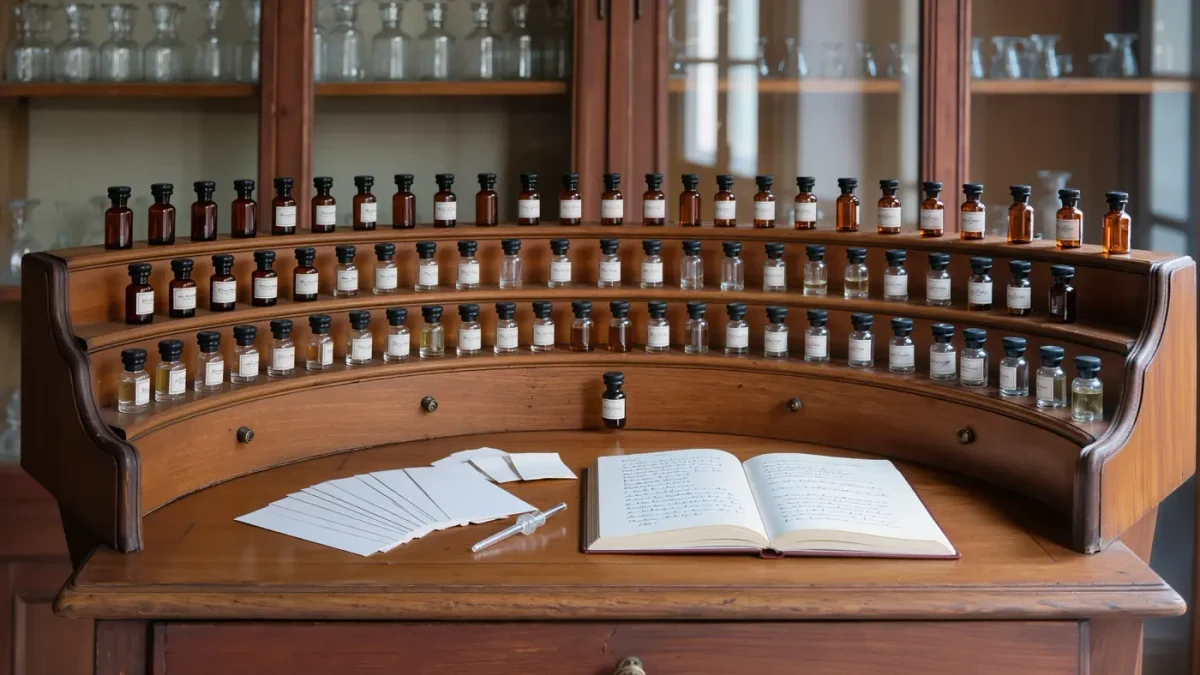
The perfumer's workstation is called an organ — a tiered, keyboard-shaped arrangement of hundreds of vials, arranged by family like the stops of a musical instrument — and its player is called a nose, the trade's word for a perfumer trained to read and compose scent. The profession's landmarks are documented precisely: Ernest Beaux built Chanel No. 5 in 1921, and Jean Carles, who ran the Grasse house of Roure and taught generations of perfumers, composed Miss Dior for the newly founded house of Christian Dior in 1947. A fashion house's fragrance — often its most profitable product line — begins at that keyboard, with a brief.
What is a perfume organ?
It is both furniture and method: a curved, stepped desk holding the perfumer's palette of raw materials — naturals like rose and jasmine alongside synthesized molecules — placed within a hand's reach so that accords can be auditioned in seconds, one drop on a blotter at a time. The arrangement is personal, indexed the way a composer indexes an instrument, and the organ of one perfumer will not match another's. The name is not a metaphor for decoration; it describes performance. A perfume is played onto paper, revised, played again, for months or years.
Who is a nose, and how is one trained?
Traditionally in Grasse, the Provençal town that processed flowers and aromatics since the seventeenth century, and later in the great composition houses that grew from it. Training means memorising thousands of materials by odour, learning accords — pre-built combinations that behave as single units — and studying formulas the way composers study scores; Jean Carles' systematic teaching method at Roure became one of the discipline's founding pedagogies. The finished nose works freelance for fragrance houses or in residence with a brand, and the profession's credits have recently moved onto the bottle itself — perfumers named on packaging, once rare, now standard for prestige releases.
How does a brief become a bottle?
A brief arrives as a few sentences: a brand, a mood, a target price, sometimes a banned ingredient list — and the nose translates it into structure, choosing top, heart and base materials that argue the brief's case. The documented classics show the range of the translation: Beaux's No. 5, with its then-radical overdose of aldehydes, turned an abstraction — 'a woman, not a flower', as the house lore has it — into modern perfume's founding text; Edmond Roudnitska built Diorissimo in 1956 as a study of lily of the valley and Eau Sauvage in 1966 around the new molecule Hedione, and both became reference points. Trials run for months; the blotter decides.
Why do fashion houses treat fragrance as signature?
Because scent is the one product a house can sell at every price point, and the one that reaches a client daily — a dress is worn occasionally, a perfume is worn as identity. That is why the organ and the nose matter beyond craft curiosity: the fragrance that carries a house's name is authored work, composed by a trained individual against a written brief, with as much technique and revision as a couture pattern. Read the credit on the flacon. Somewhere behind it is an organ, played with intent.
What is an accord?
The molecule-scale chord of perfumery: two or more materials blended so that they stop smelling like their parts and behave as a single new odour — a rose accord built from geranium, citronellol and a dozen other stops, none of which is a rose. Accords are the prefabricated vocabulary a perfumer composes with, learned by heart during training and refined over a career, and they explain why the organ is arranged like an instrument: the perfumer is not searching for a smell so much as voicing one, balancing stops that have known behaviour together. Read a finished formula and the accords show as blocks — the aldehyde complex of No. 5, the lily-of-the-valley construction of Diorissimo — written notation for smells the wearer experiences as a single breath.
How is a fragrance judged before launch?
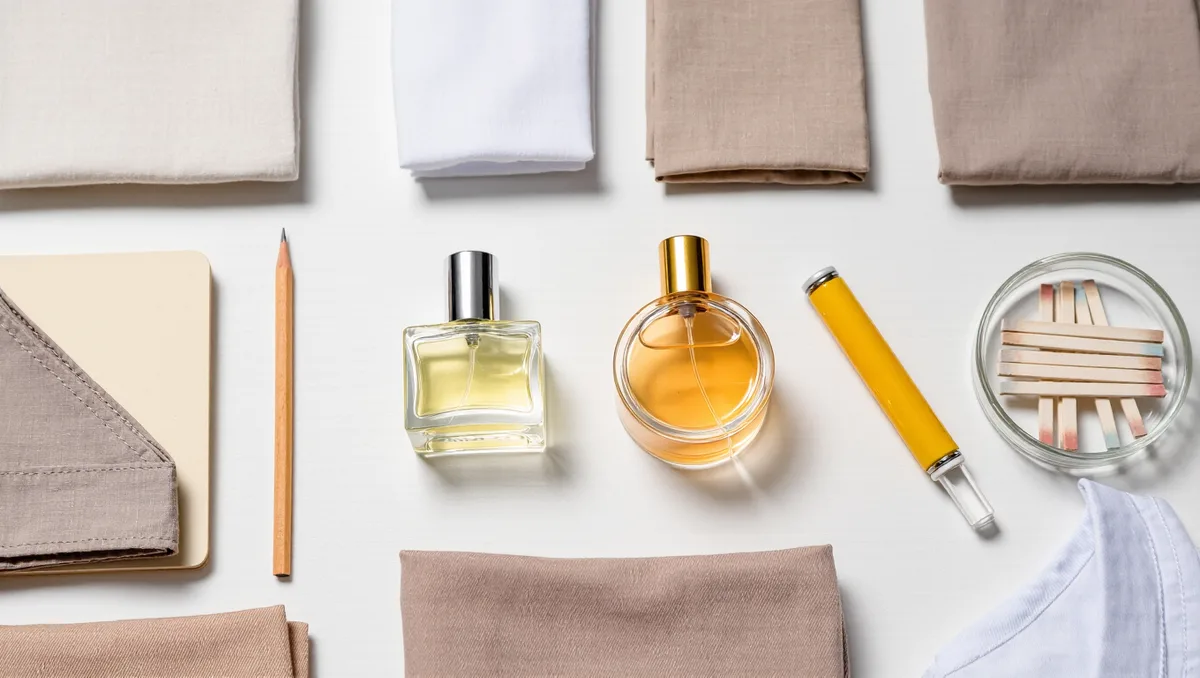
On blotters and skin, in stages. The perfumer submits trials to the client's brief-holder; the formula is reviewed on paper strips at intervals — top notes die within minutes, bases last for days, so a composition is heard across time like a piece of music — and on skin, where body chemistry and the material's own behaviour rewrite the opening. Stability, safety and cost gate the final version: a formula must survive bottles, light and months of transport, meet regulatory limits on materials, and hit its target price. Only then is the juice filled, the flacon designed by others upstream, the perfumer's name printed — increasingly, and rightly, on the carton.
What does the customer actually buy from all this craft?
A composition, which is to say a decision. Among the thousands of materials on the organ, the perfumer has selected perhaps fifty, in ratios argued over for months, so that the opening flash, the heart and the long drydown arrive in an order someone designed — the difference between a fragrance and a pleasant smell being exactly the difference between a building and shelter. The house's investment in that authorship explains the industry's economics: a signature scent is worn daily for years, and its composition, once associated with a name, becomes the most durable branding object a fashion house owns. The organ's keyboard is walked past by tourists in Grasse. What it produced is worn, invisibly, everywhere.
The organ itself rewards a second look, because its design encodes the profession's memory: vials arranged not alphabetically but by family and behaviour, in the order a formula thinks — citrus materials near the top where the perfume's opening lives, bases banked along the lower tiers where the drydown endures. An apprentice inherits or builds an arrangement over years, and senior perfumers are said to identify a colleague by the map of their desk alone. No two organs match. That is the point of the instrument: it is a biography of smelling, written in glass, on which the brief from a fashion house becomes, blotter by blotter, a signature someone can wear.