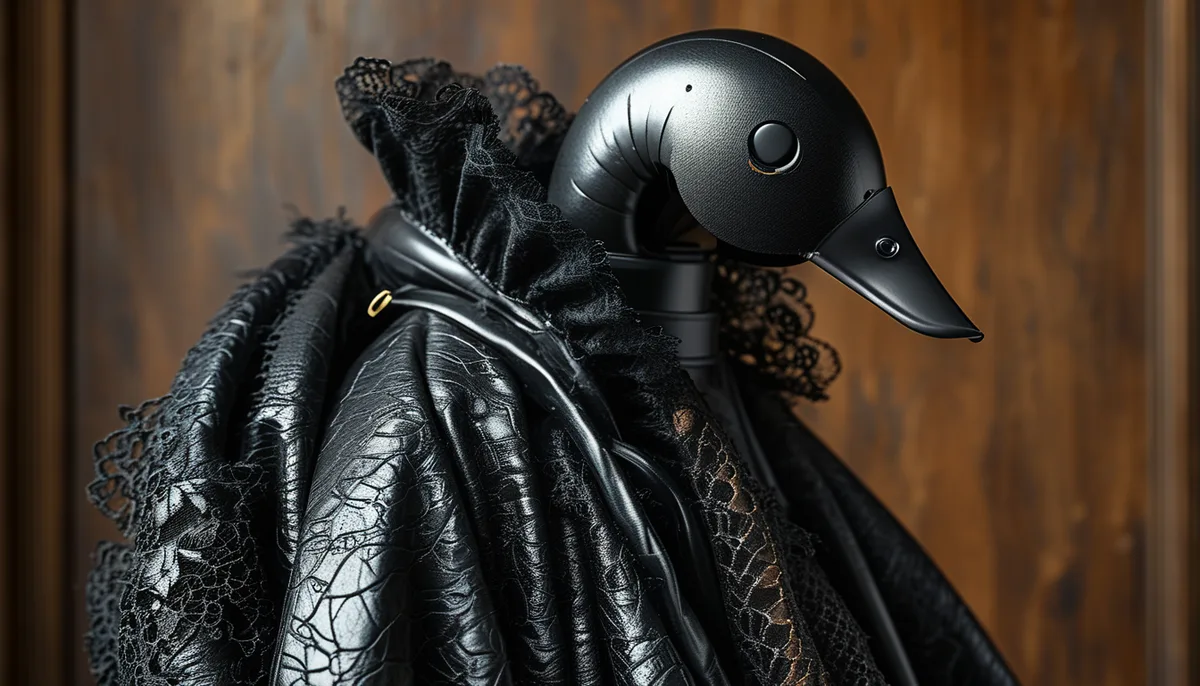
The white mask that walks a runway at intervals — powdered, expressionless, lit from within — has a four-century-old technical ancestor: the kabuki stage of Japan, where the actor's face is painted rather than made up. Kabuki dates its origins to around 1603, when the dancer Izumo no Okuni began performing her style of drama, and its paint system matured over the Edo period into a precise grammar — a white ground, oshiroi, laid over the face so that colour drawn on top could carry meaning at the distance of a theatre. Runway face paint borrows that logic: paint as information, not decoration.
What is the white face actually for?
In kabuki, oshiroi — the white powder-and-oil base — solves a stage problem first and a symbolic one second: under candle and lamplight, at theatre distance, a whitened face becomes a legible surface, like a canvas hung at the front of the body. Every line drawn on it is amplified, and expression can be written on the face as legibly as a sign. The same calculation powers the runway version — a pale ground makes a designer's silhouette, a garment's colour or a single painted line readable from the far end of a show space. The mask is not hiding the face. It is publishing it.
What is kumadori, and why does colour matter?
Kumadori — the painted line-work of kabuki's aragoto, or 'rough style', acting — is a colour code: red-brown lines for heroes, passion and righteousness; blue and violet for villains, jealousy and the supernatural. A spectator could read the moral alignment of a character before a word was spoken, which is paint performing narrative work. That is precisely what a beauty director wants from runway face paint: a system in which a washed eyelid, a blackened lip or a bleached brow changes the meaning of the clothes. Kabuki is the oldest documented proof that this works at scale.
How does the stage reach the runway?
Through fashion's long habit of citing Japan. John Galliano's Spring/Summer 2007 collection for Dior drew openly on Japanese stage and geisha imagery — powdered white faces, lacquered lips, architectural hair — and walked it into the middle of the Paris season, completing a channel that twentieth-century collections had opened in fragments: kimono line, obi structure, stage white. The editorial world absorbed the same source, and the kabuki-derived face became a recurring costume of high fashion — admired, and sometimes criticised, as a borrowed language. The borrowings are documented in the collections themselves.
What separates reference from costume?
Attribution and understanding. Kabuki's paint is a named technique in a living tradition, maintained by families and schools, so the honest runway use credits the source and reads its rules — white as surface, colour as sentence — rather than lifting the surface alone. Fashion's strongest face-paint moments, stage-white included, work because the underlying logic is respected: the makeup is doing dramaturgy, changing how a body carries a garment. The lesson of the kabuki stage is that a face can be authored. The runway's debt is to remember who wrote it first.
What is the onnagata, and why does it matter here?
The onnagata is kabuki's male specialist in female roles, and the craft rests on the same principle as the white ground: femininity constructed as legible artifice, a set of drawing decisions — the whitened face, the redrawn eye, the lip modelled small — rather than an imitation of a real woman. The tradition produced centuries of theory about which lines make a face read as one thing or another, and it is the deepest documented argument that a face can be designed. Fashion's runway borrows the conclusion constantly: the model as performer, the face as a constructed surface in the show's composition. The borrowing is legitimate; the debt is the point.
Where else does stage white surface in fashion?
Wherever a show wants the face to behave like a mask rather than a portrait: the fully powdered face has appeared across decades of European runway practice whenever designers sought distance, uniformity or unease, and fashion photography has used the same device since the silent-era studios it shared with theatre. The white face belongs to a family of stage techniques fashion keeps re-hiring — the painted line of kumadori, the mask of noh, the choreographed stillness of dance — because a runway, like a stage, is a distance-reading art. What distinguishes a thoughtful use is the same in every case: the technique is named, the source respected, and the paint is asked to do narrative work rather than decorate a novelty.
How should fashion readers evaluate a borrowed stage face?
By asking the questions a theatre historian would. Is the technique named and credited, or dissolved into a vague 'inspiration'? Does the paint perform the same work it performed at its source — a surface made legible, a colour code read as character — or is it applied as exotic surface alone? Kabuki itself has lived through centuries of outside borrowing and maintains its traditions by teaching them, which is the strongest argument that reference, done with respect, does not exhaust a source. The runway's white face is at its best when it admits it is quoting a working system: paint with rules, written long before the first fashion week, and still in performance every night in Tokyo and Kyoto.
The reader's working rule can be a single sentence: stage traditions are technologies, and technologies deserve citations. Oshiroi was engineered for candlelight and distance; kumadori was engineered for character; a runway face engineered for show lighting and photography inherits both problems and should inherit the credits too. Where fashion has done this — naming kabuki, describing the technique, drawing its lines with understanding — the resulting images hold up to scrutiny as well as to desire. Where it has not, the white reads as an empty mask, which the stage itself, with four centuries of practice, never once allowed it to be.