In 1963 the London hairdresser Vidal Sassoon cut a short, sharply angled bob on the model Grace Coddington, and the shape became known as the five-point cut — five precisely placed points, two framing the face in front of the ears, two behind them and one at the centre of the nape. The date matters. A fashionable head in 1963 was still usually built weekly out of rollers, setting lotion and lacquer; Sassoon's proposal was that the shape should live inside the cut itself. Hair, in his hands, stopped being upholstery and became architecture.
What exactly is the five-point cut?
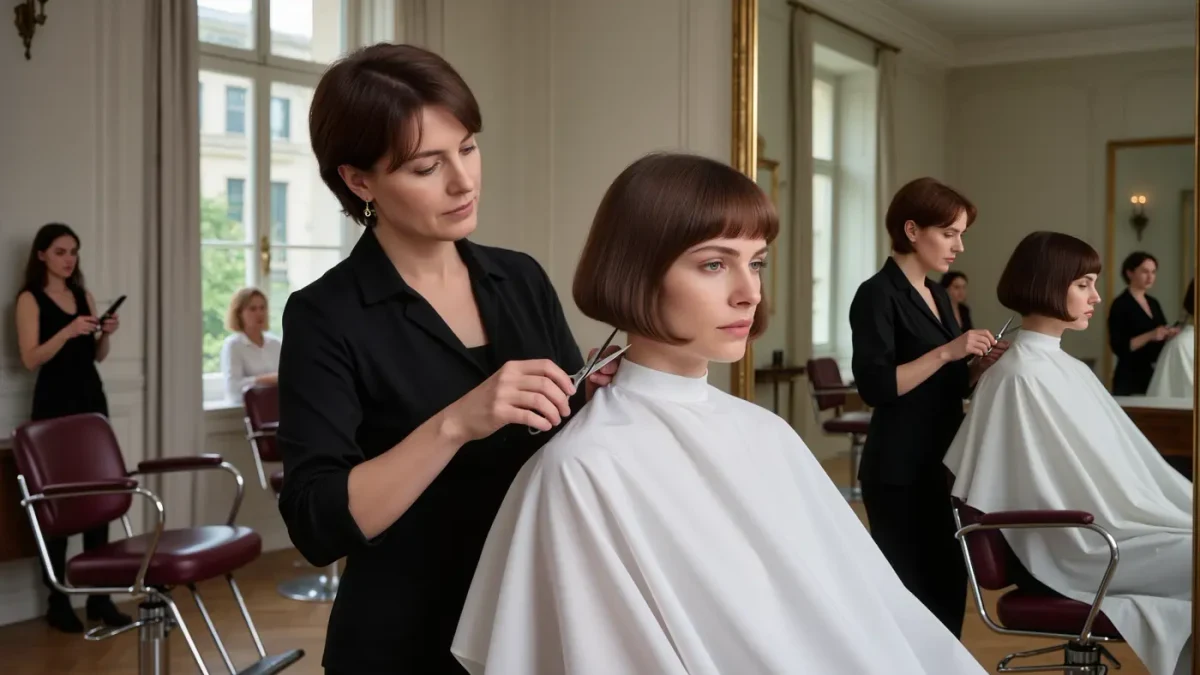
It is a chin-length bob cut freehand, with scissors alone, so that the hair's own fall supplies the styling. The five points are the places where the outline breaks — the geometric signatures that give the cut its name — and each is clipped at a deliberate angle so the silhouette reads as a drawn line rather than a softened curve. The technique behind it is precision cutting: a method in which the shape is engineered line by line against the head, with no back-combing, no curl and no spray required to hold it. Washed, dried and shaken out, the hair returns to the same shape.
Why did the salon need geometry in the first place?
Postwar hairdressing was, for the paying client, a labour of maintenance: a weekly appointment, an overnight set, a pillowcase sacrificed to pins. Sassoon, who had opened his first London salon on Bond Street in 1954, built his practice on the opposite premise — the cut as a permanent engineering decision, maintenance reduced to a shampoo. The idea was commercialised under the phrase wash and wear, and the company's later advertising slogan, "If you don't look good, we don't look good," compressed the promise into a single line. The five-point cut was the purest demonstration of the thesis: a shape so exact it needed nothing added. beauty coverage.
How did a haircut enter fashion history?
Through the same circuits as the clothes. Coddington wore the cut into the London of Mary Quant and the mod scene, where a graphic, self-maintaining head matched a graphic, self-wearing dress. Sassoon's scissors moved between salon and cinema — his crop for Mia Farrow's 1968 film Rosemary's Baby became one of the most photographed cuts of the decade. By the 1970s the Sassoon academies were exporting the method as a teachable grammar, which is the quieter revolution: hairdressing reframed as a discipline with rules, not a service with results.
Why does the five-point cut still matter?
Because it established authorship. Once the cut — not the set, not the products — carries the shape, the hairdresser becomes a named maker whose work can be signed, taught and archived, in the way a couture pattern is. Sassoon, who died in 2012 at 84, is cited in museum histories of postwar design alongside the decade's image-makers precisely for that shift. Every editorial story that credits the cutter, and every short cut presented as a design rather than a convenience, descends from the afternoon in 1963 when five points did the talking.
What should a reader take from one haircut?
That beauty's history is a history of technique, and techniques have authors. The five-point cut was not a look that happened; it was a position — geometry over setting, line over lacquer — argued with scissors and won on the head of a working model. Fashion remembers it because the argument has never needed reversing.
What does geometry mean in practical cutting terms?
It means the head is treated as a solid to be measured on. Sections are lifted at exact elevations, the scissors follow guide lines rather than the hair's old ends, and every decision — where a line sits above the jaw, how a point is bevelled — is taken against the architecture of the skull, not against a photograph of a finished style. The glossary that grew from this practice is now the industry's common language: elevation, graduation, weight line, a vocabulary in which a haircut can be specified and reproduced by a stranger on another continent. That reproducibility is the quiet radicalism. A set belonged to the one salon that made it; a geometric cut belonged to anyone who had learned the grammar.
How did the method become a school?
Through teaching rather than celebrity. From the 1970s the Sassoon academies codified the cutting system into sequences that could be demonstrated, drilled and examined, exporting trained cutters into salons and editorial teams worldwide, and the company's product lines carried the method's name into domestic bathrooms. Beauty history usually records its revolutions through pictures, but this one travelled through curriculum — a rare case of a craft reform succeeding because it was made learnable. When a modern stylist says a cut is 'too Sassoon to mess with', the reference is not a photograph but a method: an assumption that the scissors, given discipline, are sufficient.
How should a reader look at a short cut today?
With the five questions the five-point cut made standard: where does the line sit, how does the shape behave wet, what holds it when the products are gone, whose hands drew it, and what position is the shape arguing? A bob that answers those questions is Sassoon's heir, whatever the decade of the photograph. The cut of 1963 survives less as a silhouette than as a standard of seriousness — the demonstration, renewed every few seasons on a runway or a magazine cover, that the shortest hair can carry the heaviest design argument. Grace Coddington's afternoon appointment did that. Five points, one pair of scissors, and a discipline that never needed to be reversed.