The beehive — the tall, conical bouffant that crowned the early 1960s — was invented in 1960 by a Chicago hairstylist, Margaret Vinci Heldt, and it marks the moment hairstyle stopped imitating softness and started occupying space like a built object. Within three years Vidal Sassoon's geometric cuts had supplied the opposite argument, shape through subtraction rather than addition, and together the two poles defined a modern idea: hair as a designed volume, judged by line and structure. Runway fashion has been renting that idea ever since, and the architectural updo is its current lease.
When did hair become sculpture?
Arguably whenever it has been fixed into a form nature would not produce, but the twentieth century made the claim explicit. The beehive of 1960 was engineered with frames, backcombing and a then-new generation of strong-hold lacquer — a construction with an internal armature, the way a sculptor builds over wire. Its height was declarative: a silhouette visible across a room, closer to the scale of fashion's A-line than to a hairdo. The 1960s mod era turned that volume into a mass style, and photography did the rest, fixing the bouffant as the decade's vertical signature.
What is an architectural updo on today's runway?
A structure built for a single walk: folds, loops and cantilevered lengths pinned into geometry that would not survive an ordinary day, and is not meant to. The vocabulary is borrowed visibly from building and product design — cantilevers, coils, pleats — and the result is judged the way a 3D object is judged, by silhouette from every angle, balance and the shadow the form casts on the face. On the runway the hairstyle often does the same work as an avant-garde garment: it demonstrates what the house's imagination can engineer, independent of wearability.
Who builds these forms?
Named artists, because the labour is genuinely sculptural. Session hairstylists — Guido Palau and Sam McKnight are the most cited of the generation that made backstage hair a credited creative role — direct teams that construct these heads over hours, with wire, pads, pins and Lacca-class products, from sketches and references like any other design discipline. Their names appear in show reviews, their techniques are taught in masterclasses, and the top of the profession now signs campaigns and editorial stories exactly as photographers do. The beehive had an inventor; the contemporary updo has an author.
Sculpture, or just spectacle?
The honest answer is that runway hair is sculpture with a performance date — forms built to be photographed, judged and dismantled within hours, closer to theatre design than to marble in a courtyard. That ephemerality does not diminish the craft; it locates it. Fashion's hair architecture keeps the twentieth century's central discovery alive: that the head is a plinth, and that styling can be a built discipline with inventors, methods and named makers. The Met's Costume Institute has long treated clothing as applied art. Hair earned the same argument in 1960, and renews it every season the updos climb.
What materials build a runway head?
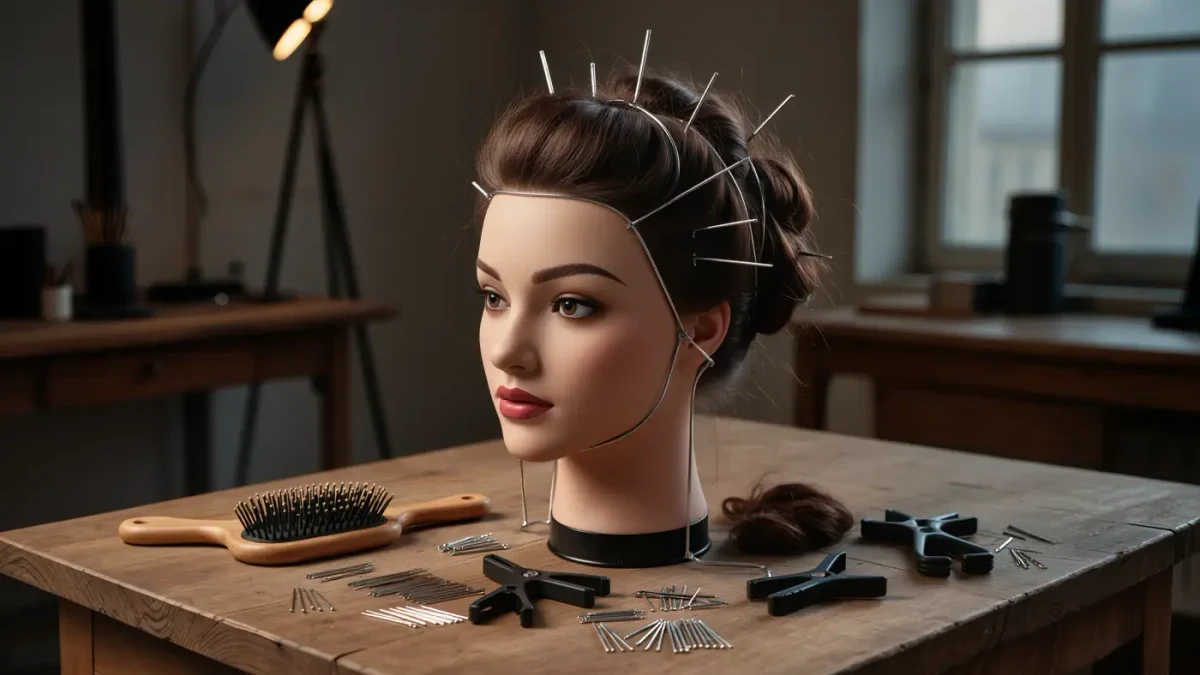
An unglamorous engineering kit: wire frames and hair pads for armature, dense backcombing for substrate, pins by the hundred, and lacquers and gels strong enough to fix a cantilever for a twenty-minute walk. Long or added hair is stitched, folded and pleated into planes; sections are ironed flat or set into architecture with heated rollers; and the finished structure is often glued, in effect, into place. Backstage teams of a dozen may work parallel heads for hours to hit a show's schedule, following look charts the way a theatre workshop follows a build sheet. The romance of the image — a weightless coil above a forehead — is the reverse of its method: gravity, all session long, is the opponent.
What did the decades after the 1960s add?
Each generation added a grammar. The 1970s loosened the monument into movement, insisting hair could be natural and still designed; the 1980s returned to volume with commercial bravado; the 1990s pared the runway head to minimalist severity, proving restraint could be as sculptural as height; and the 2000s onward re-embraced construction — braided columns, wrapped towers, folded waves — as shows turned into total design spectacles judged by image as much as garment. Through all of it the credited session stylist rose from anonymous technician to named author, the profession's equivalent of the couture atelier's premier. Hair as sculpture is not one decade's look. It is the standing possibility every decade since 1960 has exercised.
How is runway hair actually documented?
In the same apparatus as the clothes: show reviews that credit the hair direction, backstage galleries that record the construction, and the stylists' own archives of look charts and product formulas. The documentation matters because it is what converts craft into history — a beehive is dated, an updo is attributed, and the sequence from Heldt's 1960 invention through Sassoon's 1963 geometry to the present season's towers can be written as a continuous discipline rather than a string of fashions. Museums have begun collecting this material alongside garments, and beauty education teaches the lineage explicitly. A discipline with records is a discipline with authors. Runway hair has both now, and the plinth stays busy.
One more distinction completes the argument: sculpture in hair is built on a living, moving substrate. Hair grows, sweats, sheds and fights, which is why the discipline's best practitioners are described less as stylists than as engineers of a difficult material — holding a form against biology for the length of a show, with nothing permanent at stake. Fashion has always prized such mastery over uncooperative cloth; bias-cut silk and raw denim are its customary difficulties. That hair, the most personal of materials, became a runway medium at all — cut by 1963 into geometry, built by 1960 into towers, engineered each season since — remains the quiet marvel underneath every photograph.