Glass skin — the Korean beauty ideal of skin so hydrated and even that it reads as translucent, reflective glass — crossed into Western beauty language in the late 2010s, popularised in English largely through the retailer and media platform Soko Glam and its co-founder Charlotte Cho around 2018. The scale behind the term was industrial: by 2021 South Korea had become one of the world's top three cosmetics exporters, shipping over nine billion dollars of product a year. Within a decade of the Korean wave reaching Western shelves, the face the magazines wanted had changed — matte gave way to light, powder to water.
What is glass skin, exactly?
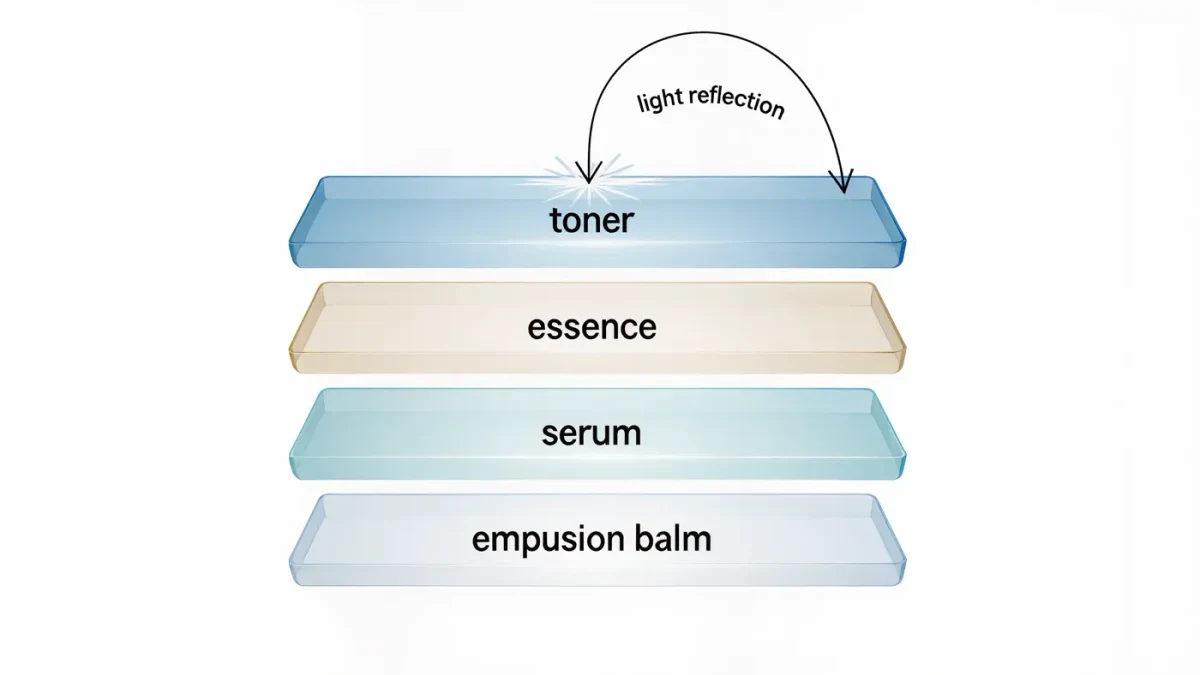
It is a finish, not a product: skin plumped by layered hydration — toner, essence, serum, the emulsion steps of the famous multi-step routine — until the surface is smooth enough to reflect light continuously, without matte interruption. The routine structure is the point: skincare understood as preparation long before makeup begins, with the makeup's job reduced to preserving translucency rather than covering it. Where Western editorial beauty historically built a face from paint upward, K-beauty built it from water downward.
How did the ideal reach the Western editorial face?
Through product first, vocabulary second, imagery last. Cushion compacts — portable cases holding a sponge soaked in liquid foundation, introduced by the Korean company IOPE in 2008 — taught Western users that base makeup could be dewy by design, and imports of sheet masks, essences and ampoules rebuilt the Western bathroom shelf. Then the term arrived: 'glass skin' gave magazines and beauty desks a name for the look, and once named, it could be commissioned. The editorial face of the late 2010s — glossy cheekbones, visible texture of light, no powder line — is that commission answered.
What actually changed backstage?
The direction of labour inverted. Makeup artists who once reached for blotting paper and loose powder to erase shine were now instructed to add it — facial oil on the cheekbone, balm on the lid, gloss as structure — and the 'no-makeup makeup' of the 2010s converged on the K-beauty surface from the other direction. Skin prep became the longest part of a backstage face chart, and celebrity beauty imagery moved the same way, away from the dry, airbrushed matte that had signified glamour since the silent era. Shine stopped being a flaw to be corrected and became the desired result itself.
Is a finish enough to count as a change in standards?
Yes, because finish carries meaning. Matte traditionally coded discipline, control and the mask; glass skin codes health, softness and a face that appears unarmoured — a different proposition about what a beautiful face is for. The change also relocated authority: Western beauty now routinely looks to Korean innovation for method and vocabulary, and trend coverage reads Seoul the way it once read Paris. A decade is a short time in beauty, but the light has moved, and the editorial face has moved with it.
What is an essence, and why did it matter?
The essence — a watery, fermented, treatment-step liquid between toner and serum — became the emblem of the K-beauty method because it does almost nothing a Western product category was built to do: no colour, no coverage, no visible styling, only hydration and conditioning repeated in layers. Its success forced Western retailers to create shelf space for steps that could not be explained in a single benefit claim, and it carried the routine logic with it — that skin is prepared in sequence, over time, by the user, rather than corrected in a chair by a professional. The editorial face absorbed the same lesson. Glow, the images quietly acknowledged, is prepared, not applied.
Did the trend change what Western brands actually sell?
Documentably yes. Sheet masks moved from novelty to standard fixture in Western drugstores; cushion foundations were adopted by nearly every major Western base brand after proving the format in Korea; essences, ampoules and water-based layering products entered prestige lines; and 'skinimalism' and skin-prep vocabulary now structure how base makeup is marketed. The beauty press tracks Seoul launches the way it tracks Paris collections, and Western houses routinely acquire or imitate Korean texture technology. A decade earlier, such product pipelines ran almost exclusively toward Asia from the West. The traffic reversed, and the glass skin finish — light over matte, water over powder — is the aesthetic receipt of that reversed trade.
What should a reader make of the ideal itself?
Soberly, as a standard among standards. Glass skin is genuinely a craft achievement — layered hydration is technique, and the routine rewards consistency the way hairdressing rewards a good cut — but it is also a commercial ideal, manufactured by the same industry that profits when a previous ideal falls. Its editorial success lies in a real aesthetic shift: light instead of powder, surface instead of mask, preparation instead of correction. Its honest criticism is that no face is actually glass, and the imagery's closeness to visible skin texture became the next decade's argument. Beauty's pendulum moves here too. The decade's legacy is not that glass skin is final, but that the light — once turned on — has never fully been turned off.
The vocabulary itself is the residue. Terms like glass skin, chok-chok and dewy moved from Korean marketing into English-language beauty journalism within a few seasons, and once a word is in circulation, the look it names is permanently available to be commissioned again — the way 'bombshell' or 'androgynous' never quite leave the beauty desk's toolkit. Whatever the next finish is, it will be described against glass skin, in a language K-beauty supplied. That is the measurable cultural shift: not just a look adopted, but the terms of the discussion rewritten, with the source clearly traceable to Seoul's product pipelines and the retailers who carried them west.