Isamaya Ffrench — born in London in 1989, trained in product and industrial design rather than cosmetics — built her career by treating the face as a site for ideas: body paint, latex, industrial hardware, piercings worn as jewellery. The documented milestones describe an unusual ascent. In 2020 she became the creative director who launched Byredo's first makeup line, translating a Swedish fragrance house's cool minimalism into colour; in 2022 she founded her own label, Isamaya Beauty, opening with an 'industrial' collection that packaged lip colour with the visual grammar of clubs and hardware stores. Beauty, her work argues, belongs to the same culture as music and nightlife — not to a separate, softer category.
Where did the face-paint approach come from?
From design school and London nightlife rather than the salon. While studying product design at Central Saint Martins, Ffrench painted faces for clubs and events, and the practice became a technique: the face as a three-dimensional object to be constructed upon, the way a product designer approaches a form. The work moved from parties into print — she became a leading contributor to Dazed's beauty pages and then a beauty editor there — and into campaigns, where her painted, distorted, sometimes unsettling faces offered magazines an alternative to retouched convention. Self-taught in makeup, she brought a maker's logic to it.
What does beauty direction mean in her hands?
Treating a campaign as a world rather than a photograph. At Byredo, where she led the launch of the house's first makeup collection in 2020, the products were designed as objects — colour matched to the brand's austere Scandinavian register, packaging treated as product design, which was literally her training. At her own label from 2022, the 'industrial' first collection made the reference explicit: rubberised textures, hardware-inspired detailing, a beauty vocabulary borrowed from subculture rather than luxury. In both cases the credit that matters is creative direction, the same title a designer or a photographer holds.
Why call it beauty for the music generation?
Because her visual sources are the ones a festival and club audience already reads: body paint, jewellery worn through skin, latex, slogan and glitch. Ffrench's work emerged from the same London scene that shaped a decade of music imagery, and her campaigns deliberately speak that language back to it — beauty as participation in a culture, not preparation for respectability. The commercial result is the proof: brands now commission precisely the unsettling, paint-forward imagery that a previous beauty establishment would have rejected as unwearable.
Is provocation a sustainable brand strategy?
The record so far says it can be, when the provocation is method rather than gesture. Ffrench's disturbing images are underwritten by disciplined technique — precise painting, engineered colour, product design rigour — which is why they convert: the audience reads intention, not chaos. Her career to date documents the change in the beauty industry's own taste: the establishment of 2010 and the establishment of 2026 differ chiefly in that the former would not have hired her, and the latter cannot market without the licence she represents. The provocateur, as of the mid-2020s, holds the keys.
What did the early editorial work look like?
Unsettling on purpose: faces covered in printed text, mouths hidden under prosthetics, brows painted where brows do not grow, bodies used as canvases in the tradition of body painting rather than cosmetics. Published across fashion magazines' most experimental pages and increasingly commissioned for campaigns, the work traded in the uncanny — beauty imagery that refused reassurance — and built its audience among readers formed by music videos, club fliers and festival culture, who recognised the register immediately. The commercial world's initial caution dissolved as the imagery proved its pulling power; provocation, it turned out, photographed memorably, and memorability is the one metric campaigns cannot buy twice.
What does her career change for the profession?
It upgrades the ceiling. Before this generation, a makeup artist's ambition realistically ended at creative direction of another company's line; Ffrench's path — from painting friends' faces at Central Saint Martins to launching a Swedish house's first cosmetics and then her own label — establishes that the beauty image-maker can be the founder, holding the brand rather than renting a name to it. For the industry's hiring logic, the effect is visible: beauty campaigns increasingly credit a named director, casting the artist as an author whose reference library includes industrial design and nightlife rather than the salon canon. The provocateur, in this telling, is not a mood. It is a job description.
How does the design training show in the brands?
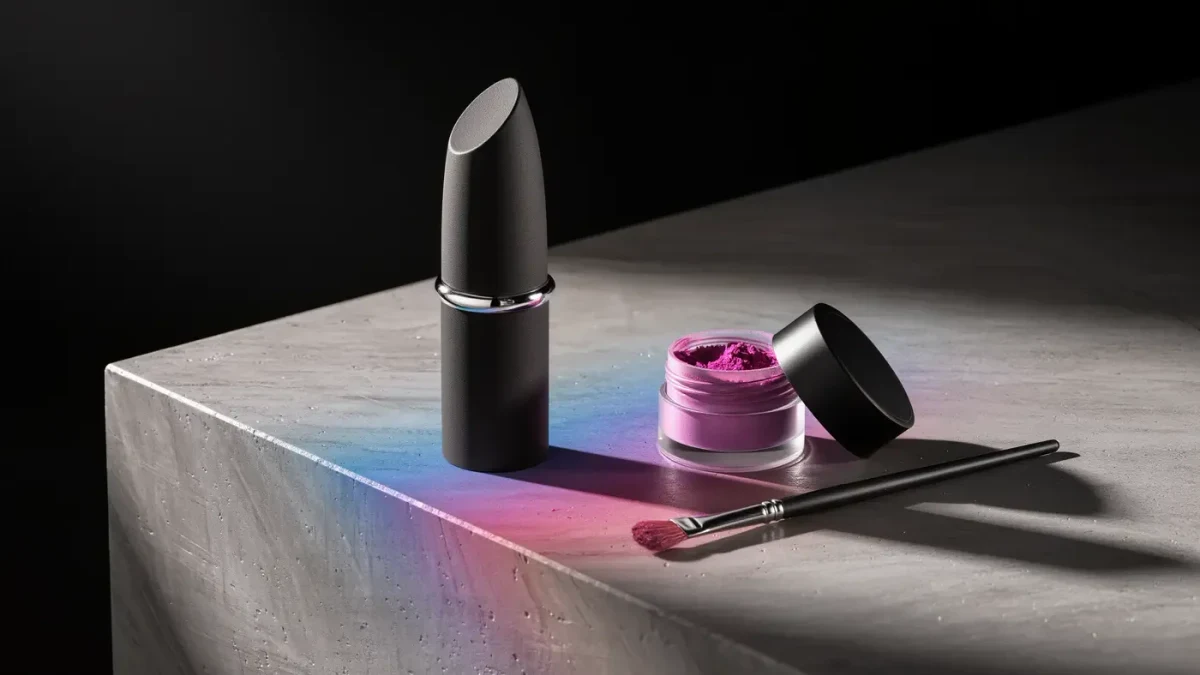
In the objects first. Product design taught her that packaging is the product's face, and both the Byredo launch and Isamaya Beauty treat the case, the texture and the gesture of use as designed decisions rather than afterthoughts — a lipstick that behaves like an industrial component, a palette that reads as a hardware object on a shelf. The same logic governs the imagery: a campaign is specified like a product brief, with references, materials and failure conditions, not briefed like a mood. This is why her work translates across price points without losing identity. A designer's language survives manufacturing. The beauty campaign built that way survives a decade too.
The chronology is worth stating plainly, because it moves quickly: a 2010s decade of editorial and campaign image-making across the major fashion magazines and houses; 2020, the Byredo Makeup launch under her creative direction; 2022, the founding of Isamaya Beauty with the industrial collection; and continuing campaign and editorial direction since. Few beauty careers compress that arc — subculture to house launch to label — inside a single decade, and none did it with imagery this deliberately resistant to polish. The speed is the argument made visible: the establishment did not merely tolerate the provocateur. It scheduled her launches.