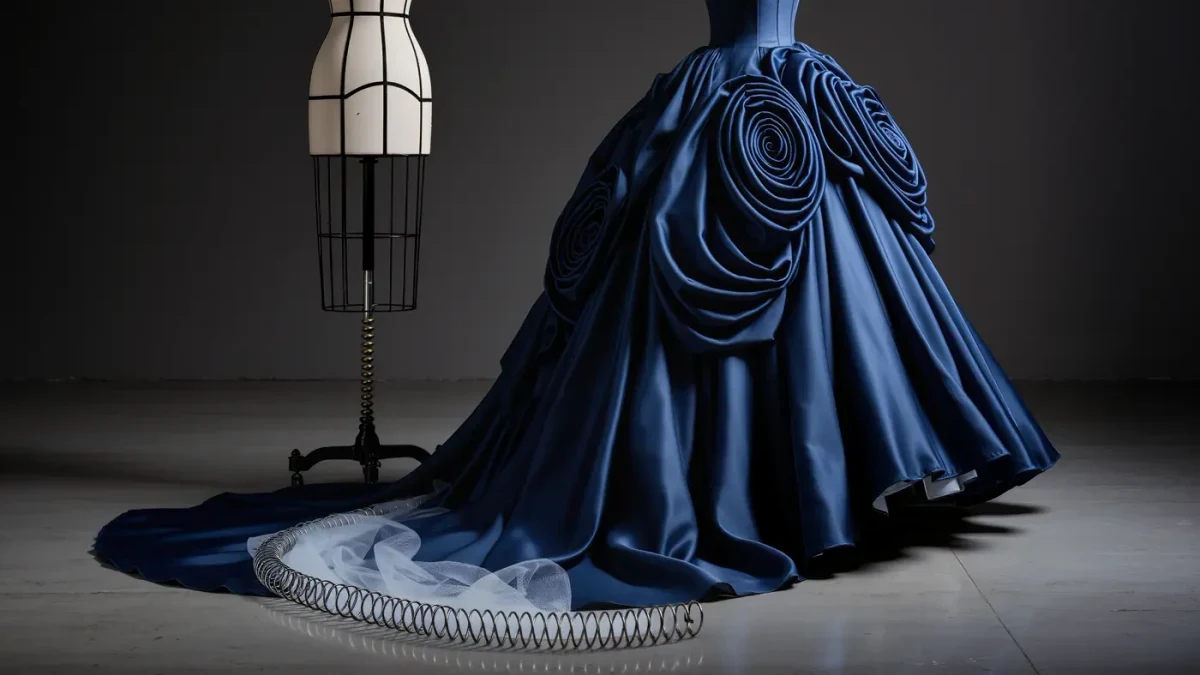
Charles James made the ball gown into a piece of engineering, cutting and boning and layering each evening dress until it stood, pivoted and swirled on a body the way a structure stands on foundations — and in 2014 the Metropolitan Museum of Art devoted its Costume Institute exhibition Charles James: Beyond Fashion to proving the point with x-rays, animations and conservation analysis. He was, by the museum's own framing, less a fashion designer than a sculptor in cloth, a self-declared artist who happened to bill clients. The claim was grandiose; the gowns, mostly, were not.
Who was Charles James?
He was born in 1906 in Sandbach, England, to an English father and a Chicago heiress mother, and he spent his career crossing the Atlantic as decisively as he crossed the boundaries between tailoring and dressmaking. After early training with an Italian-Australian milliner in Chicago and a first salon in the same city in the late 1920s, he worked in London — where he showed during the war years and counted Cecil Beaton and the young Dior among his observers — before establishing the New York practice that made his name. From 1947 to 1955 he operated from 9 East 52nd Street in Manhattan, producing the couture collections on which his reputation now rests; the business failed repeatedly, in the pattern that would define him as vividly as any silhouette. He died in New York in 1978, in poverty, two years after the Costume Institute acquired his papers and workroom archive.
What made the ball gowns different?
They were built, not draped. James's signature evening dresses — the Tree gown of 1955, the Four-Leaf Clover of the same season, the Butterfly of 1954, the Spiral of 1952, the swan of his last years — were constructed from dozens of pattern pieces, interlined with nylon net, horsehair and spiral steel boning, so that the skirt held a sculpted volume without a crinoline and moved with a controlled, springy recovery when the wearer turned. Conservation studies of the Met's holdings have shown some gowns containing more than twenty-five pattern pieces and internal corset-like supports weighing several pounds. He described his own method, in interviews collected by the Met, as one of continuous revision: a dress could go through dozens of iterations before leaving the atelier, because for James the gown was a problem to be solved rather than a look to be sold. Whether every problem needed that much solving is the honest critical question — the dresses weigh heavily, and their rigor can read as rigidity.
The ball gown as systems design
James thought of a gown as a set of load paths. The bodice carried the skirt; the skirt distributed its weight to the hips and the petticoat architecture; the hem, cut in engineered spirals, governed how the whole rotated in motion. He spoke of his clients in the vocabulary of an engineer, naming anatomical pivots, and he kept charts and diagrams of proportion alongside his patterns, material that the 2014 exhibition rendered as animated x-rays of dresses in motion. His admirers called this genius, and his creditors called it something else — the same perfectionism that produced the Four-Leaf Clover consumed fittings his calendar could not afford. The record supports both readings at once.
Why did the Met stage him in 2014?
Because his archive survived him as an argument. In 1976 James deposited his life's documentation with the Costume Institute — patterns, toiles, photographs, correspondence — turning himself into the rare couturier whose process is as legible as his product, and curator Harold Koda, with co-curator Jan Glier Reeter, built Beyond Fashion around that evidence. The exhibition opened the Anna Wintour Costume Center in May 2014 and used animation, CT-style scanning and full ensembles to present the gowns as constructed objects; critics divided, some finding the show a overdue canonisation of America's only true couturier, others a museum's rescue of a difficult legacy whose designer had quarrelled with nearly everyone who funded him. Both camps, at least, were arguing about construction — which was the argument James had spent fifty years trying to start.
What does James leave to design?
A demonstration that dressmaking can be structural research, and a warning about what that research costs its maker. Designers who revisit voluminous engineering — the boned bustle dresses, the spiral hems, the architectural ball skirts of the decades after his death — are working in his shadow whether or not they name him, because he proved that a skirt's volume can be generated by its own cut and internal structure rather than by underpinnings. Charles James died believing he had been underestimated, and the museum record has since corrected the ledger: the Metropolitan Museum holds the gowns, the papers and the argument, and the argument still holds.
How did the gowns actually move?
The 2014 exhibition's most persuasive evidence was kinetic. James designed for motion — he spoke of the swirl as a timed event, the skirt's recovery after a turn as the gown's real signature — and the museum's animated studies showed dresses captured on film rotating, hem spirals opening and closing like shutter blades, the internal net recovering the sculpted line within seconds. The designs were fitted on live models dozens of times; his longtime mannequins and society clients functioned, in effect, as test instruments. This is why conservation matters to his case: x-rays of the gowns reveal decision layered on decision, pattern pieces revised against each other, weights balanced — the physical record of a perfectionism that the salons' account books could never afford. The dresses are his documentation, and they argue better than the legend does.
His influence also travelled by people. The pattern-makers trained in his workroom carried his methods into American studios for decades, and the designer publications of the 1950s — from Vogue's editorials to Beaton's books — circulated his silhouettes as images long before the gowns entered museum vitrines. What the 2014 retrospective added was the process, and that is the exhibition's lasting contribution to design history: it shifted James's story from personality to construction, from the parties and bankruptcies to the pattern blocks, and made the Costume Institute's holdings the primary text. A designer once remembered as a character is now studied as a corpus.