Fashion's favourite abstraction — that a garment is a structure before it is a look — has a dated, named origin in textiles: Anni Albers, who joined the Bauhaus weaving workshop in 1922, exhibited her woven pictures at the Museum of Modern Art in 1949, and published On Weaving in 1965, a book that treats cloth as architecture in miniature, built thread by thread from decisions a designer makes at the loom. Her argument was that structure is the content, and it remains the most rigorous framework anyone has offered for thinking about what fabric actually is.
Why did weaving choose her, or she it?
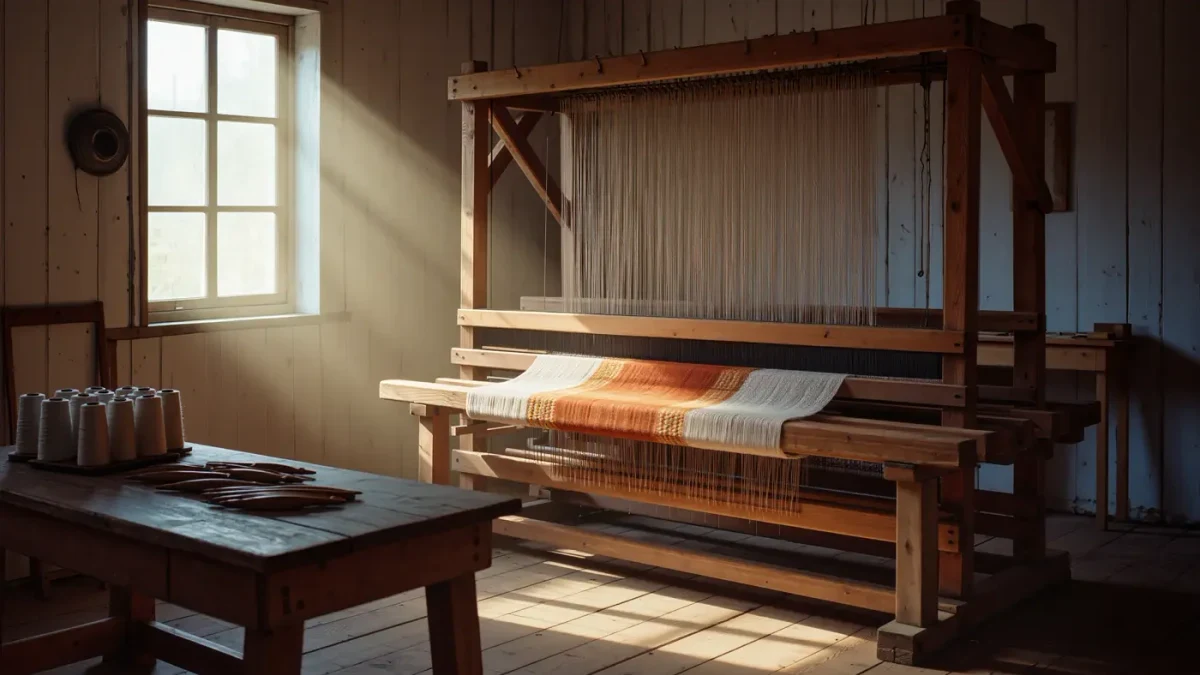
Partly by exclusion, and she was candid about it. Albers — born Anni Fleischmann in Berlin in 1899 — entered the Bauhaus in Weimar, where the school's workshops admitted women only into the weaving workshop in practice, and she made the constraint into a method: rather than resenting the loom, she studied it as a machine for thinking. A woven cloth is a grid, and a grid is a set of decisions — warp and weft, the vertical and horizontal threads fixed on the loom; pattern is the order in which they meet; texture is the intervention in that order. Albers pursued the logic until the textile behaved like a modern painting or a piece of typography, with the grid visibly organising everything. When the Nazis forced the Bauhaus's closure and the Alberses emigrated in 1933 to teach at Black Mountain College in North Carolina, she carried the discipline with her and kept loosening it: light-reflective synthetics, cellophane woven into yardage, drapery fabrics engineered to absorb sound — materials chosen for performance, not prettiness.
What exactly did On Weaving argue?
That cloth is the oldest technology of civilisation and the least examined. On Weaving, published in 1965 after decades of teaching, intersperses short essays with photographs of Peruvian textiles, machine diagrams and her own work, and reads weaving as a shared grammar across centuries: the Inca and the industrial jacquard loom — the loom controlled by punched cards, a direct ancestor of computing — belong, in her telling, to one continuous engineering history. The book's central claim, restated throughout her teaching notebooks, is that art lives in the performance of how a thing is made rather than in its literal subject: as she formulated it in her own notes, art is concerned with the how, not the what. For anyone designing cloth — or clothing made of cloth — this reverses the usual hierarchy, in which pattern is applied to a neutral ground. Albers insists there is no neutral ground: the ground is already the design.
Did the art world listen in time?
Slowly, and with qualifications. Her 1949 MoMA exhibition was a landmark — a solo museum show devoted to a weaver, an unprecedented category for the institution — yet the craft-versus-art debate trailed her for decades, since textiles sat on the wrong side of every medium hierarchy the twentieth century enforced. The postwar years brought murals and architectural commissions, including sound-absorbing wall panels, and a late-career turn to printmaking in the 1960s and 1970s, when she translated woven structures into printed grids on paper. The full reassessment arrived long after her death in 1994: major retrospectives travelled through the decade that followed, including the 2018–19 exhibition at Tate Modern in London, which presented the weavings not as applied art adjacent to painting but as a parallel modernism with its own physics. History, on Albers's terms, simply caught up with the loom.
The delay carries its own lesson: the categories — artist, craftsperson, designer — did the damage, not the work. Albers signed her weavings like paintings, exhibited them like paintings and titled them like paintings, while insisting, in print and in teaching, that the comparison itself was a category error. A weaving is not a flattened picture but a structure that has learned to face the room, and judging it by pictorial standards mistakes the front for the whole.
What does her lesson mean for fashion now?
It names the difference between textile as supply and textile as authorship. Albers showed that a fabric's intelligence — its drape, its stretch, its breathability, its memory — is designed into the interlacing, not added at the cutting table, and the fashion practice that honours her is the one that starts from the mill: knits engineered as structure, jacquards built with the pattern inseparable from the ground, cloth whose behaviour in the body was decided at the loom. The fashion industry's chronic separation of “design” from “fabric development” is precisely the division Albers spent a career refusing. Her work also sharpens a contemporary dilemma: she wove synthetics in the 1930s for durability and light, and the same engineering fluency is now demanded of fashion in reverse — materials judged not only by performance but by what they cost the material world.
Where should a newcomer start with Albers?
With the grid, ideally in person. Collections at the Museum of Modern Art and the Art Institute of Chicago hold major examples of her weavings and printed work, and On Weaving remains in print — a short book that can be read in an evening and that permanently changes how a hand reads any cloth it touches, from a bath towel to a couture tweed. The lesson she left is deceptively simple: look at a fabric and ask not what it depicts, but what decisions hold it together. The answer, in her work, was always the art itself.