Artificial intelligence art is imagery produced by software that has studied enormous numbers of existing pictures and learned to generate new ones from a written prompt. Type a phrase, and the system assembles an image it has never seen before, built out of patterns it absorbed from everything it was trained on. The question it raises for working artists is not whether the pictures look finished. Many do. The question is what the finished surface actually contains, and who owns the labor inside it.
This piece explains the machinery in plain terms, then looks at what changes for painters, illustrators, photographers and designers whose work feeds the machines. It argues one thing throughout: an AI image is a synthesis, not a source. The old skills of looking — of knowing where an image comes from — matter more now, not less.
How does AI-generated imagery actually work?
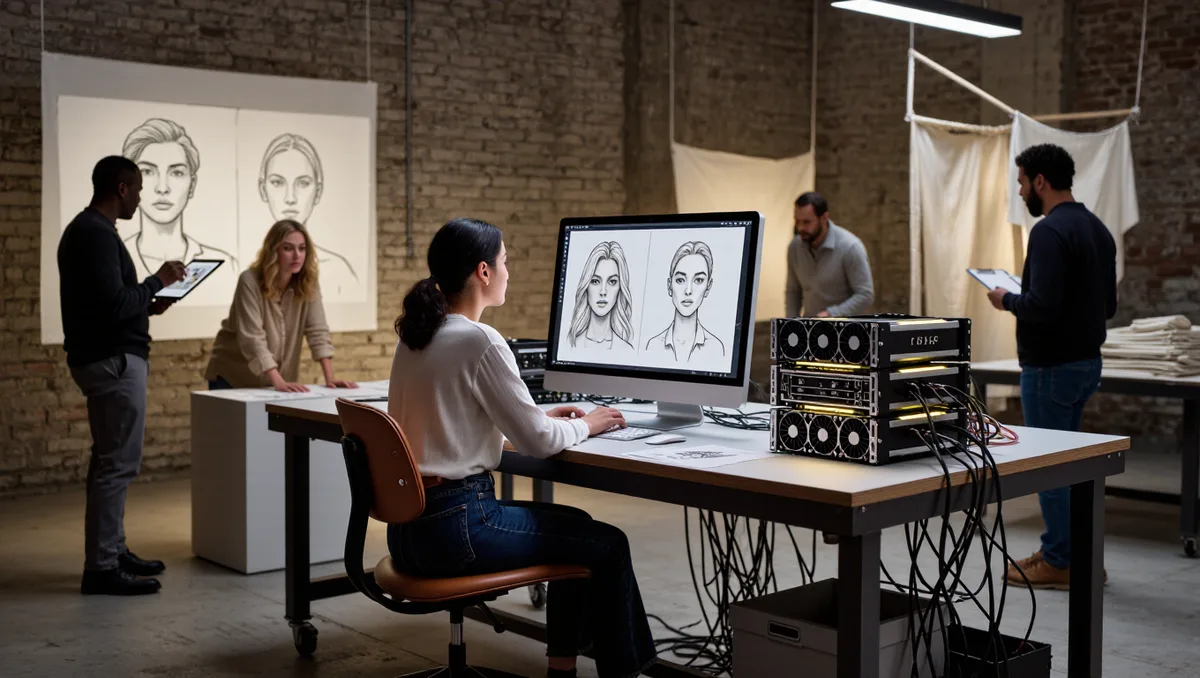
Most of today's image generators belong to a family of systems trained on huge collections of pictures paired with written descriptions. During training, the software learns statistical connections between words and visual features: how "oil painting" tends to look, how light falls in a "golden hour" photograph, how a face is usually arranged. It does not store the original pictures the way a folder does. It stores tendencies.
When you type a prompt, the system starts with visual noise — random static — and gradually refines it, step by step, toward an image that matches the description. The result is new in the strict sense that no exact copy exists. It is not new in the sense that nothing stands behind it. Every choice the model makes traces back to the images it learned from, most of them made by people who were never asked.
That is the honest description of the process: pattern synthesis at very large scale. The image is assembled, not drawn. There is no canvas, no revision history, no hand correcting a line at two in the morning. For related coverage, see Before the Factory: Andy Warhol's Shoe Decade, When a Hand Drawn Line Paid the Rent.
What does "real" mean when the picture never existed?
Language is the first place to look for clarity. Merriam-Webster defines "real" as having objective independent existence — and, pointedly, as "not artificial, fraudulent, or illusory: genuine." By that standard, an AI-generated image is real as an object: the file exists, it can be printed, hung, sold. What it lacks is the other kind of realness — a lived origin. No one stood in the light it depicts. No model held the pose. The picture has the look of experience without the experience.
This distinction matters for art because art has always traded in both kinds of realness. A photograph earns authority from the moment it records. A painting earns it from the accumulated decisions of a hand. An AI image borrows the surface authority of both without inheriting either. That is not automatically disqualifying — collage and appropriation have long made art from borrowed surfaces — but it changes what the viewer is being asked to trust.
What does this change for working artists?
Three practical shifts are worth naming, and none of them requires a statistic to see.
First, the market for certain routine image-making tasks — stock-style illustration, quick concept drafts, decorative filler — is under real pressure, because a prompt is faster and cheaper than a commission. Work that was valued mainly for being adequate is the most exposed.
Second, provenance has become a professional skill. Artists, editors and picture researchers now have to ask of every image what a good researcher asks of every quotation: where does this come from, who made it, and is the credit true? The habits are the same ones this magazine applies to a season, a collection title, an image credit. Checking the source is the work.
Third, the training-data question has moved from a technical dispute to a live legal and ethical one in several countries, with artists and rights holders challenging how their work was collected and used. The details vary by jurisdiction and are still being settled, so the durable advice is general: artists should keep records of their own work, read the terms of any platform that ingests it, and understand that "publicly available online" has never meant "free to reuse."
What can a human artist do that the machine cannot?
The machine can synthesize a style. It cannot originate a reason. A painter's picture carries a biography of decisions — what was rejected, what was repainted, what the artist was looking at and why. That trail is invisible in the final object, but it is what critics, curators and collectors have always been reading. It is also what cannot be prompted.
The practical answer for artists is not to compete with the generator on speed or volume. It is to deepen the things a synthesis cannot supply: a specific viewpoint, a documented process, a relationship between the work and a real subject. Artists who can show their working — sketches, studies, the source photograph, the failed canvas — offer something the output of a prompt structurally lacks: an account of itself.
There is also a quieter point. Looking at images closely has always been the core skill of both making and judging art. A reader who has learned to read composition and symbol in a painting — the way our guide to reading a painting sets out — is far harder to fool by a confident synthetic surface, because the surface is exactly where the tell usually is: hands, text, reflections, the logic of light. The errors cluster where the model is imitating rather than understanding. This connects to our earlier piece, How to Read a Painting: A Beginner's Guide to Composition, Color and Symbol.
Is AI imagery art, or is it a tool?
Both, depending on who is holding it. As a tool, it is already ordinary: image editing, upscaling, mood boards, quick visual drafts. Used this way, it sits alongside the camera obscura, the projector and the airbrush — aids that changed technique without replacing judgment. As an end-to-end image maker, it produces objects whose claim to be art rests almost entirely on the prompt writer's intent, since the execution involves no making in the traditional sense.
History offers a useful parallel rather than a verdict. When photography arrived, painters were told painting was dead; instead it shed its documentary duties and became something more deliberately its own. When Warhol turned commerce into subject, the art world's categories bent and held. The lesson of those episodes is that art absorbs its tools by redefining what the human contribution is. The current absorption is happening faster and at larger scale, which is genuinely new. The underlying negotiation — between the machine's output and the artist's intention — is not.
Our analysis, stated plainly: treat AI-generated imagery as a material with a supply chain, like any borrowed fabric or found photograph. Ask what it is made of, who contributed to it, and whether the person presenting it can account for it. Art that can answer those questions survives scrutiny. Art that cannot was always more surface than work.
Where does this leave the viewer?
With more responsibility, and better tools for it. The viewer's task used to be discrimination between good and bad pictures. It is now also discrimination between kinds of pictures: made, recorded, and synthesized. None of the three is illegitimate. Each makes a different claim, and honesty consists in labeling the claim correctly.
The evidence assembled here establishes the mechanism and the stakes; what remains unknown is how the legal and market questions will settle, and those are being decided now, case by case and jurisdiction by jurisdiction. What does not remain uncertain is the value of the trained eye. The more images flood the world, the more the ability to look slowly — at a canvas, a photograph, a garment — becomes the scarce skill. The machines can generate the picture. Only the looking can tell you what it is worth.