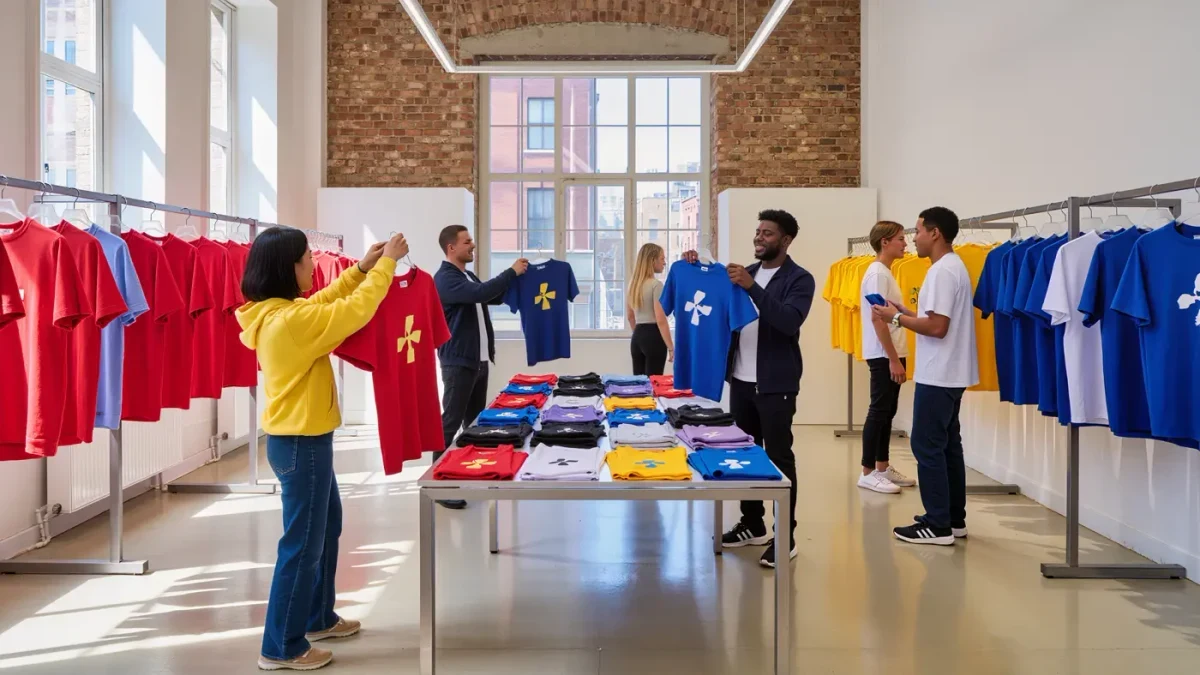
Long before every museum gift shop doubled as a boutique, Keith Haring settled the question in a store of his own: the Pop Shop, opened at 292 Lafayette Street in SoHo in April 1986, sold his radiant babies, barking dogs and dancing figures as T-shirts, posters and buttons at prices a teenager could pay — a few dollars for a button, roughly ten to fifteen for a shirt. Haring, then one of the most visible artists in New York, treated the store not as a betrayal of art but as an extension of it, and the 1986 experiment is the hinge on which the modern art-commerce-fashion relationship still turns.
Where did Haring's imagery come from?
From the street, literally. Haring arrived in New York from Pennsylvania, studied at the School of Visual Arts, and in the early 1980s began drawing in chalk on the blank advertising panels — matte black paper sheets intended for future ads — in the subway stations, producing hundreds of drawings between 1980 and 1985 in front of commuters. The style that resulted — thick contour, cartoon speed, no shading, universally legible — was a design for public space, and the figures that emerged, the radiant baby, the barking dog, the crawling figure, became a civic alphabet. Museums, including the Whitney Museum of American Art, eventually exhibited him, but the work's premise stayed public: imagery meant to move at street speed, owned by no one and recognized by everyone.
Why open a shop instead of a gallery show?
Because the shop was the honest version of what was already happening. By 1985 Haring's drawings were being stolen, bootlegged and resold on street tables, and unauthorized dealers were profiting from his imagery while collectors paid gallery prices for the originals. The Pop Shop answered with a radical simplification, which Haring stated plainly in interviews of the period: the shop made his work accessible to everyone, with prices low on purpose. He commissioned the store's interior as a total artwork — boldly striped floors and walls covered edge to edge in his own painting — so that shopping became an immersion in the work rather than a transaction beside it. A second Pop Shop opened in Tokyo in 1987; the SoHo store continued after his death and closed in 2005. Proceeds, the Keith Haring Foundation records note, supported children's programmes and AIDS charities — Haring had been diagnosed with AIDS and died of it in February 1990, at thirty-one.
What did the critics say in 1986?
That he had sold out — and Haring's defense became the era's clearest theory of art and commerce. He argued, in published interviews and statements, that the accusation assumed art was corruptible by contact with money, whereas his subway drawings had always been free, public and prolific; the shop merely gave the public a legitimate way to own the imagery. He also insisted the shop was a painting first and a store second, and photographs of the interior support the claim: every surface worked, like a three-dimensional version of his panels. The episode is now taught as the moment the artist-merchandise model acquired its vocabulary — accessibility, authorship, total design — decades before limited-edition drops and museum collaborations normalized it.
It is worth pausing on how unusual the store's premise was in 1986: a living artist of museum standing opening fixed-price retail in the downtown commercial district, with no gallery between him and the customer, and with the cheapest item in the shop carrying the same image the galleries were selling for thousands. The art press treated the price structure as the scandal; Haring treated it as the whole point, arguing that the aura of an artwork need not depend on scarcity, and that an image repeated widely enough becomes a public possession regardless of who owns the objects. That argument — familiarity as a form of ownership — is now the unstated theory behind every artist collaboration and every museum merchandise floor.
How does Pop Shop connect to fashion?
Directly, and by precedent. Haring had already crossed into clothing and performance contexts in the early 1980s — he painted graffiti-inspired jackets and accessories, created backdrops for the downtown club and fashion scene, and collaborated with the designers and performers of the early-1980s New York scene, including Vivienne Westwood, whose collections incorporated his prints in the mid-1980s. The Pop Shop completed the circuit: it proved that an artist's imagery could be a commercial system with its own retail architecture, price ladder and identity, which is the operating model of every subsequent artist-designer collaboration. When a luxury house installs an artist's motifs on a bag, or a museum sells a printed tee as its headline product, both are running Haring's 1986 playbook, usually without the painted floors.
The Foundation's stewardship points the way: Haring's imagery is licensed selectively and documented in public collections, so the repetition continues without the signature dissolving. An imagery built to survive the subway — scrawled fast, read at a glance, owned by everyone — has so far proven the only kind that can survive the merch economy without losing itself.
Would the Pop Shop work today?
It is working, everywhere, under other names. The differences are instructive: scarcity has replaced accessibility, with drops engineered to raise prices rather than hold them low, and charity has largely disappeared from the formula. The Pop Shop's remaining radical element, in other words, is not the merchandise but the price and the purpose — art imagery sold cheap so that everyone could own it, with the proceeds passing to the causes the artist named. That is the part of the 1986 experiment fashion's merch economy has been slowest to copy, and the part most worth remembering.