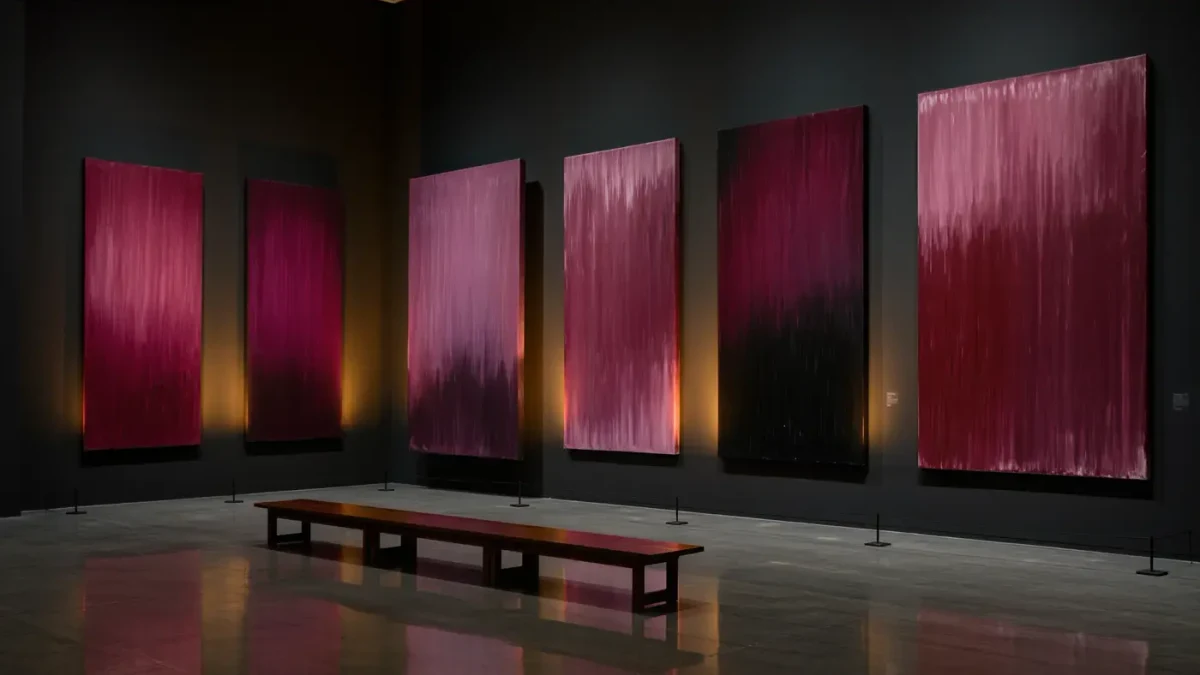
The monochrome coat argues what Color-field painting proved first: that a single unbroken surface, scaled past the body's expectations, can carry more feeling than any composition laid upon it. The proof arrived in paint — Mark Rothko's luminous stacked rectangles and Barnett Newman's vertical zips, the slender lines splitting a field of colour — during the late 1940s and 1950s; the Tate received nine of Rothko's Seagram murals in 1970, the year of his death, and rooms built for them have been teaching viewers ever since that colour at scale is not decoration but weather. Dressing, sooner or later, takes the same lesson: one colour, held over the whole body, until the body reads as a field.
What did Color-field painters actually invent?
A way of removing the image while keeping the intensity. In the late 1940s Rothko began the stacked, soft-edged rectangles for which he is known — columns of colour hovering on a ground, edges so diffused the boundary seems to breathe — and he insisted, in statements of the period, that his subject was basic emotion rather than arrangement; Newman went further, reducing painting to a single field interrupted by one or two vertical bands. The critic Clement Greenberg grouped such work under the term Color field in the 1950s, distinguishing it from the gestural abstraction — the dripped, aggressive brushwork — of Pollock and de Kooning. The common discovery was that scale plus saturation produces an encounter: a painting two metres high does not show you a picture, it surrounds you, and the Tate's Rothko room, where the murals hang in low light, remains the canonical demonstration.
Why do the Seagram murals still set the standard?
Because of what they renounced. Rothko accepted a commission in 1958 to paint murals for the Four Seasons restaurant in the Seagram Building in New York, then withdrew from it in 1960, returning the money — by his own account disgusted at the idea of his paintings dining behind the wealthy — and eventually giving nine canvases to the Tate in London. They arrived in 1970, on the day his death was announced, in maroons and near-blacks that close the luminous palette down toward dusk. The murals matter here because they show the monochrome's stakes: a field of colour is not empty, it is a controlled environment, and the wardrobe that learned this learned it from the same logic. A coat in a single saturated or muted colour, worn floor-length, wraps the wearer in a scaled surface that meets the viewer the way the murals meet the visitor — first as weather, then as person.
The wardrobe's translation is easier to feel than to define, and it starts with a distinction the painters also depended on: monochrome is not the absence of information but its concentration. A garment in a single colour asks the viewer to read what the painters asked them to read — saturation, temperature, how the surface absorbs or throws light, and how much of the field the eye can hold before the colour begins to move. Walk past a Rothko and the rectangles seem to deepen or recede as the viewing distance changes; walk past a floor-length coat in undivided colour and the same physics applies at body scale, which is why the silhouette feels architectural even before cut and cloth are considered. The painters only supplied the proof that this works; the wardrobe supplyed nothing so formal, which is why the argument here runs on affinity.
How did dressing borrow the lesson?
By way of affinity more than direct influence, and the honesty of that distinction matters. There is no documented pipeline from Rothko's studio to a tailor's atelier; what exists is a shared minimalism that matured in the same postwar decades and converged in the 1990s, when designers such as Jil Sander and Raf Simons's early menswear made the floor-length single-colour garment a position rather than a default, and Comme des Garçons's shows of the 1980s had already treated cloth's colour and volume as content in itself. The structural borrowings are specific: the elimination of print so the surface reads whole; the tonal dressing — one hue varied slightly across several garments — that mimics a painting's ground and hovering rectangles; the floor-length silhouette that lets fabric fall as a field rather than a fit. Glossed in wardrobe terms, tonal dressing means dressing entirely within one colour family, and it is the closet's closest translation of the Rothko room.
That the same criteria of survival apply to the paintings' afterlife. The Seagram murals have never left display since 1970, and the Tate room built for them is one of the few museum spaces routinely described by visitors in terms usually reserved for weather or music — an effect produced by nothing except scale, palette and patience. Those are, conveniently, the only tools a coat has too, which is why the analogy between the murals and the monochrome wardrobe has held for decades without either side needing to admit it exists.
What does monochrome dressing argue?
That presence can be a substitute for statement. The minimalist coat withdraws the information a print or a logo would supply and asks the surface to do everything, which is exactly the wager of a Newman zip or a late Rothko: remove the incident, and whatever survives is real. The wager can fail — an unscaled monochrome is merely a uniform — but when it works, the garment behaves like the murals: it slows the viewer down, holds the eye at the surface, and lets colour perform as the entire content. Rothko's murals, seen at the Tate today, still teach the discipline; the coat is simply the lesson at body temperature.