Madam C.J. Walker, born Sarah Breedlove on December 23, 1867, near Delta, Louisiana, turned a private struggle with hair loss into a company that made hair care for Black women at national scale. Her Madam C.J. Walker Manufacturing Company sat in Indianapolis from 1910. The Guinness Book of World Records lists Walker as America's first self-made woman millionaire.
The documented record rewards a close read. An orphan at seven and a laundress earning about a dollar a day in St. Louis, she built a factory, a school, and a national sales force in little more than a decade. Then she gave much of it away, on her own terms.
What did the Walker System actually sell?
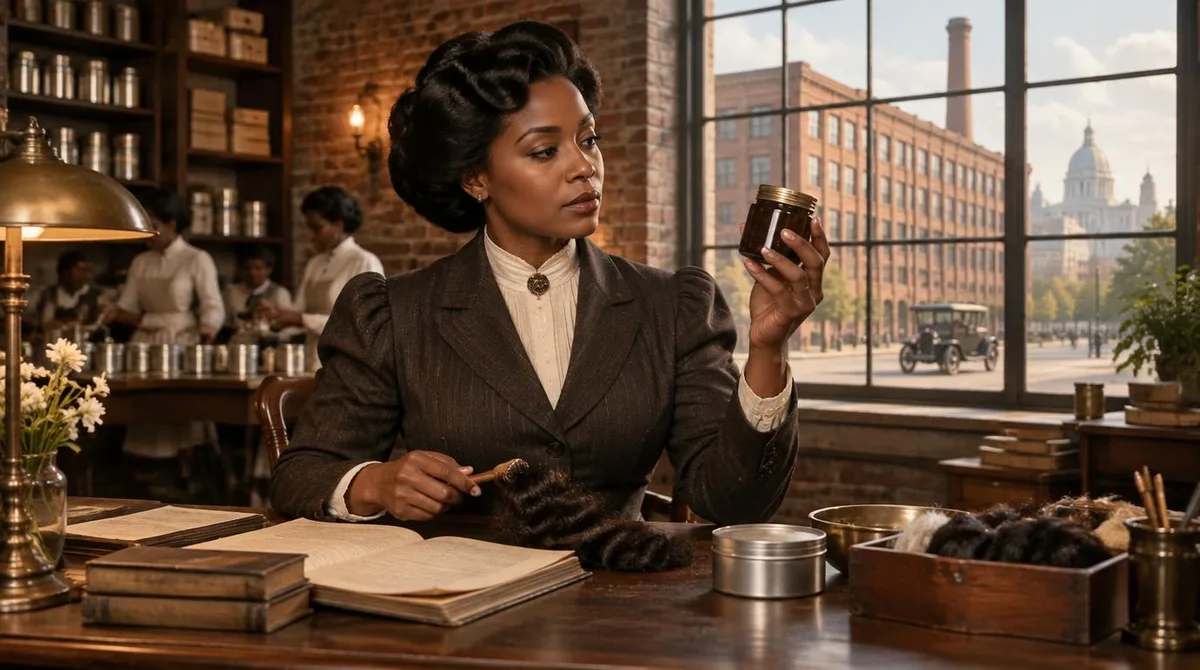
A method as much as a jar. Walker had suffered scalp ailments and hair loss, which she linked to harsh products and the labor of washing clothes. Her system answered that damage: a shampoo, a pomade said to help hair grow, strenuous brushing, and the careful use of iron combs. She sold door to door at first, teaching women how to groom and style their hair, and the goods traveled in tin containers carrying her image. This connects to our earlier piece, Serge Lutens at Shiseido: Building a House Image From a Face.
The knowledge mattered as much as the formula. A Walker purchase came with instruction, and instruction built the loyalty that selling alone could not.
How did the sales force work?
Walker trained her agents in the Walker System, opening a beauty parlor and Lelia College in Pittsburgh in 1908 to prepare licensed hair culturists. By 1917 the company claimed to have trained nearly 20,000 women. The National Women's History Museum puts the number employed across the United States, Central America, and the Caribbean as high as 40,000.
Mail order ran alongside the door-to-door work. In 1906 Walker put her daughter, A'Lelia, in charge of the mail-order operation in Denver, and the family split the map between them: the mother on the road, the daughter at the desk. For related coverage, see Anti Aging Skincare: The Truth About Anti-Aging Ingredients That Actually Work.
Agents earned commissions rather than wages, which turned sellers into owners of their own small trade. The force also organized. In 1917 the first annual conference of Walker agents met in Philadelphia with 200 attendees. It stood among the first national gatherings of women entrepreneurs, with prizes for top sellers and for charitable work in their towns.
What did she build in Indianapolis?
A full company, not a kitchen trade. From 1910 the Indianapolis headquarters held a house, a factory, a hair salon, a beauty school, and a laboratory for research. Women held posts through the management and the staff. The National Women's History Museum records sales exceeding $500,000 in the final year of her life.
Walker advertised heavily in Black newspapers and traveled often to promote the line. In 1917 she founded the National Negro Cosmetics Manufacturers Association, a trade body of her own field.
Where did the money go?
Into institutions, on a scale few individuals of any background matched. Walker pledged $1,000 to the Senate Avenue YMCA building fund and covered tuition for six students at the Tuskegee Institute. She gave $5,000 to the NAACP's anti-lynching fund, then the largest gift from an individual in its records.
In 1917 she commissioned Vertner Tandy, the first licensed Black architect in New York City, to design Villa Lewaro in Irvington, New York. The house cost $250,000 and opened as a gathering place for community leaders. Her will directed two-thirds of future net profits to charity.
Conclusion: why the record still holds
Walker died on May 25, 1919, at fifty-one, seen as the wealthiest Black woman in America. In the 1920s her company pushed into Cuba, Jamaica, Haiti, Panama, and Costa Rica.
The pomade was the product; the deeper invention was a system that trained Black women to earn, organize, and give on their own account. A century on, the paper trail of that system remains the firmest thing in her story. It needs no embellishment to hold.