Avant garde fashion is clothing made as an argument before it is made as a garment. The phrase borrows from art, where the avant garde describes the artists working ahead of the accepted taste of their moment. In dress, it means silhouettes that refuse the body's usual outline, construction that shows its own logic, and collections that behave less like wardrobes and more like exhibitions.
The movement has no single founder and no fixed uniform. What its designers share is a method: they begin with a question — what is a sleeve for, what is a dress, who is a jacket for — and let the answer reshape the cloth. The result can look difficult, even unwearable, and that difficulty is often the point. The clothes ask the viewer to reconsider what clothing is allowed to do.
This guide sets out where the idea came from, which designers carried it, and the techniques — asymmetry, deconstruction, exaggerated proportion — that give the aesthetic its recognisable shape. It also asks the practical question underneath the theory: what any of this means for the person standing in front of a mirror.
Where does the term avant garde fashion come from?
The phrase is borrowed outright from art history. In painting and sculpture, the avant garde named the movements that broke with academic convention — work that looked wrong to its first audience and later looked like a turning point. Fashion took the same word for the same reason. A garment that changes what a dress can be plays the role a radical canvas plays in a salon.
That borrowing matters, because it explains how the clothes are meant to be read. An avant garde collection is judged less by flattery than by idea. Does it advance the vocabulary of dress? Does it pose a question the industry had stopped asking? The connection runs in both directions, and the border between the two fields is thin enough to walk — our coverage of art returns to that shared ground often, because the designers who matter most here tend to think like artists first.
The term also sets expectations. Nothing in it promises comfort, versatility, or a flattering line. It promises priority of concept. When a critic calls a collection avant garde, the compliment is about ambition, not about whether the coat would survive a commute.
Which designers define the movement?
The house most often named first is Comme des Garçons, founded by Rei Kawakubo. According to Onrec, the label has consistently challenged the boundaries of fashion, with designs that blend bold concepts and wearable art, and a recognisable language of oversized silhouettes, asymmetrical cuts and layered textures. That description is a fair summary of the house's method: the garment is a proposition, and the proposition is the product.
Around Kawakubo sits a wider group of designers who work in the same key. Martin Margiela built a practice out of deconstruction — garments that displayed their seams, linings and repurposed materials as though the making were the message. Rick Owens trades in elongated, architectural proportions that treat the body as a plinth. Yohji Yamamoto and the Japanese school generally favour volume and asymmetry over the tailored hourglass, letting black cloth fall in shapes that seem drafted rather than draped.
The lineage reaches further back, too. Elsa Schiaparelli ran a house where a dress could carry a surrealist joke, and the runway has argued with itself ever since — a history we traced in our profile of Elsa Schiaparelli. Alexander McQueen pushed the show itself toward spectacle and theatre, asking whether a runway could carry the weight of an artwork — the question our piece on Savage Beauty takes up in full. The names differ; the posture is the same. Each treated fashion as a medium with its own critical tradition, not as a service industry for taste. We covered a connected angle in The Museum Settled It: Alexander McQueen, Savage Beauty, and the Runway as Authorship.
What are the signature silhouettes and techniques?
Three techniques recur, and together they form the visual grammar of the style.
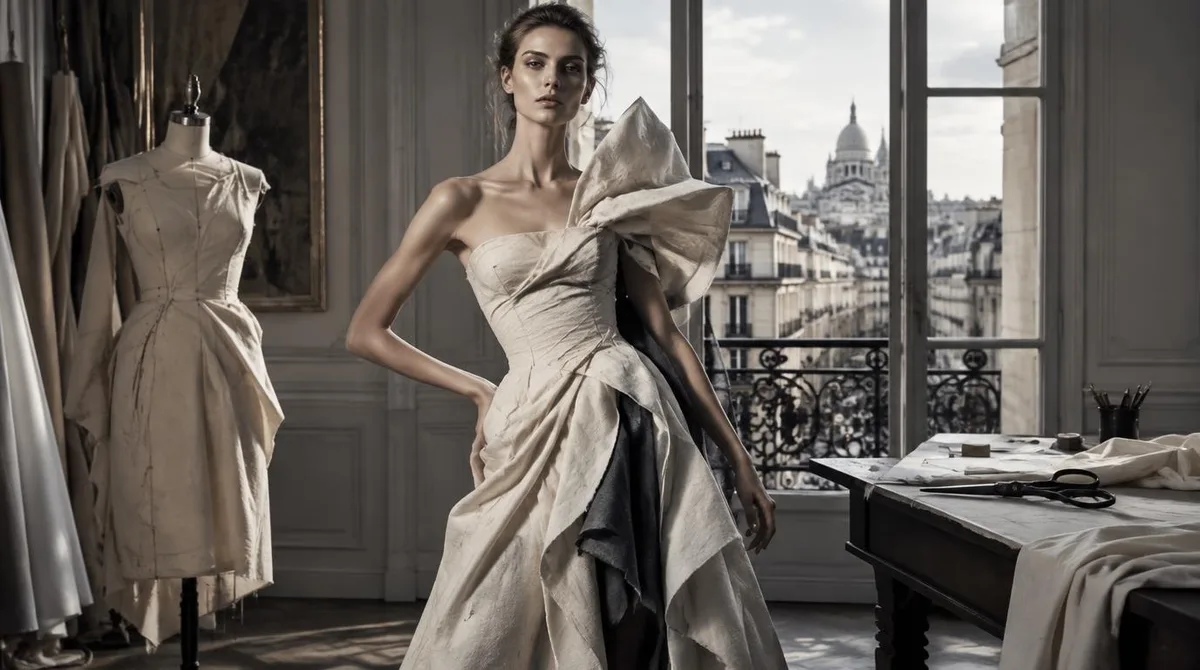
- Asymmetry. One shoulder, one hem, one seam off balance. The tilt signals that the garment was composed, not fitted — a deliberate refusal of the symmetrical body that conventional pattern-making assumes.
- Exaggerated proportion. Volume where the body expects none: sleeves like sculptures, shoulders extended past their natural line, hems that pool or balloon. The silhouette becomes a drawing of the body rather than a copy of it.
- Deconstruction. The inside turned out — exposed seams, raw edges, visible linings, cloth that looks reassembled. The technique treats construction itself as ornament, an idea our feature on the seam as signature follows through the wider industry.
Texture does quiet work alongside these. Layered fabrics, unexpected materials, and finishes that read as surface rather than pattern all keep the eye moving. Colour, when it appears at all, tends to arrive as a single decisive note rather than a palette — black above all, because black flattens distraction and lets form carry the argument.
What this means is simple to state and hard to execute: in avant garde fashion, the technique is never hidden. In a conventional garment, good construction disappears. Here, it is the subject.
How do you wear avant garde fashion without it wearing you?
The honest answer is that the clothes ask for commitment, but not for costume. The usual advice from stylists runs along one line: let one difficult piece speak, and keep everything around it quiet. An asymmetric coat over plain trousers reads as intent. Five difficult pieces at once read as a display.
Fit still matters, paradoxically. Even the most radical silhouette sits on a real body, and the designers who work in this mode are exacting about where their volumes begin and end. The garment may abandon the body's outline, but it does not abandon the body. Buying fewer pieces, chosen with care, serves the aesthetic better than accumulating a wardrobe of statement items that compete with each other.
There is also a question of context, and it deserves a plain answer. Avant garde fashion was never designed for every room. Part of its meaning is that it changes the room it enters. Wearing it is a decision about which rooms matter to you — and the growing streetwear crossover, where houses like Comme des Garçons now sit beside sneakers in the same wardrobes, has made that decision easier and more ordinary than it once was. The ideas have moved from the runway into daily dress, one hoodie and one exaggerated shoulder at a time. For related coverage, see From Sketch to Runway: How Fashion Collections Are Made, One Garment at a Time.
Why the movement still matters
Every era of fashion needs its argumentative wing. The safe centre of any industry drifts toward repetition; the fringe keeps the vocabulary growing. Avant garde fashion is that fringe with a theory attached — the part of the field that insists a hemline can carry an idea, and that clothing is one of the arts rather than merely one of the trades.
The evidence for its influence is visible everywhere the mainstream borrows its gestures: the oversized coat in a high-street window, the exposed seam on a mass-market jacket, the asymmetric hem on a dress that would have looked eccentric a decade ago. What the movement established is that fashion's boundaries are drawn in pencil. What remains unknown, in every season, is which of today's difficult collections will look, in hindsight, like the next turning point.