Mary Quant did not simply shorten the skirt; she built a working system — boutique, production line, mass ranges, cosmetics — through which young women could dress modern on a salary, and when the Victoria and Albert Museum opened Mary Quant in April 2019, it framed her as the designer who took fashion out of the atelier and handed it to the street. The mini is the headline, but the invention that matters is ordinariness treated as style: clothes for buses, offices and flats, made in Britain, sold cheaply, replaced often. Quant ran fashion as a daily habit rather than an occasion.
How did Mary Quant start?
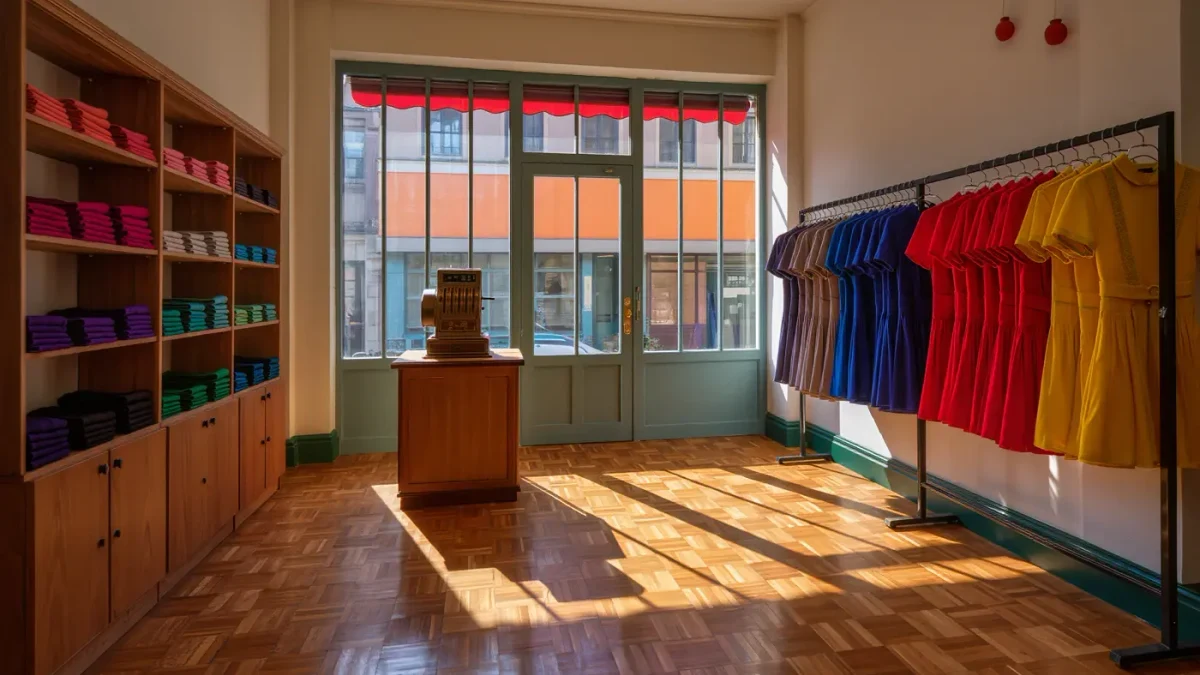
She started with a market she belonged to. Born in London in 1930 and trained at Goldsmiths, Quant took an apprenticeship with an attractive hatmaker in Mayfair called Erik, whose nickname for her — a broomstick — later became her brand mark; in November 1955 she and her future husband Alexander Plunket Greene, with the lawyer Archie McNair, opened Bazaar at 138a King's Road in Chelsea. The shop mixed borrowing-stock jewellery, printed stockings and her own early garments, bought fabric on morning market runs, and sold to the young Chelsea crowd that in 1963 Life magazine would label the Chelsea Set. Early bestsellers, as she recorded in her 1966 autobiography Quant by Quant, included short pleated skirts and coloured tights; the clientele was the first postwar generation with wages, no memory of rationing and no patience for its mothers' tailors.
Did Mary Quant invent the mini?
The honest answer is that the hemline had several midwives and Quant had the name. Courrèges and Cardin in Paris were showing short skirts within the same few seasons, and the rising hem was as much a social movement as a designer decision; Quant herself, in her memoir, credited the customers, and specifically one 1950s dancer whose skirt she kept shortening until the client said no — writing that it was the girls in the street who demanded the length. What is documentably hers is the popularisation: the low hemlines of 1964-66, the pinafore dresses worn with tights in the house's own colours, and the name itself, which per Quant's memoir came from her favourite car, the Mini. In 1963 she launched the Ginger Group, a lower-priced wholesale line that carried the look beyond Chelsea, and in 1966 she received an OBE — photographed, by her own account, in a short jersey dress and beret. The mini became a word for the sixties because Quant's version was the one sold, copied and worn at scale.
The system around the skirt
The shop was only the visible part of an unusually complete business design. Quant moved production to a purpose-built plant in Streatham to supply the Ginger Group at volume, licensed the name internationally from the mid-1960s — including ranges for the American department stores, with the first franchise in 1965 — and in 1966 launched the Mary Quant cosmetics line, packaged in the flat-lidded compacts and daisy logo that J. Aaron design work turned into retail objects in their own right. By the decade's end, per the V&A's exhibition research, her operation was producing dozens of ranges a year and selling in numerous countries. Critics of the period noted the cost: speed and licensing thinned the design, and by the 1970s the collections' edge had dulled even as the business grew. The trade-off was deliberate — access was the product.
Why does the V&A credit her so heavily?
Because the museum's 2019-20 exhibition, curated by Jenny Lister, rested the case on garments and paperwork rather than legend: some 200 objects, most crowdsourced from the public through a 2018 call for sixties wardrobes, alongside company records, licensing documents and the cosmetics archive. The show traced the whole apparatus — Bazaar, Ginger Group, the make-up, the footwear and hosiery licences — and argued that Quant democratised fashion's production, not merely its hemlines. Mary Quant died in April 2023 at 93, and the obituaries, from the BBC to the trade press, reached for the same formula: she dressed the sixties. The V&A's quieter claim is better — she industrialised the idea that what a young woman already wears is what fashion is for.
What did her critics say?
The record includes serious objection, and it sharpens her case. British trade commentators of the mid-1960s worried that cheap, fast, youth-driven fashion would degrade standards of making; Paris couturiers largely dismissed the boutique model as unschooled; and feminist critics have since divided over the mini itself, some reading it as liberation, others as commodified exposure — a debate Quant's customers, she noted, settled by wearing it or not. Her published answers were practical rather than theoretical: she argued that choice was the point, that a young woman deciding her own hemline was the system working. The V&A's exhibition absorbed the criticism rather than avoiding it, displaying the licensing sprawl alongside the vintage garments, so that the visitor could judge both the machine and its speed. The design historical verdict — everyday modern as a deliberate invention, not an accident of the decade — rests on that full record.
Her retail innovations deserve the same billing as the hemline. Bazaar's window displays, staffed like happenings, made the shop itself a design object; the hotpants, waterproof mini-capes and PVC raincoats the house produced treated weather, sport and work as design problems rather than occasions; and the Butterick paper-pattern licence of 1963, per the V&A's catalogue, let home sewers cut Quant dresses themselves — access carried to its logical extreme. Each mechanism moved fashion further from the salon and closer to the high street, which is precisely the achievement the 2019 exhibition curated: not a skirt, but a supply chain for youth.
The international spread followed the same logic. Quant shops and licensed corners opened across North America, Europe and Japan through the late 1960s, per the company's records, and the dance-name boots, tights and accessories carried the house's look into categories its founder never cut herself. By the time she stepped back from day-to-day design in the later 1970s, per her memoir's account, the point had been proven: a fashion system addressed to the young, priced for the employed and supplied at industrial speed was no longer an experiment but the industry's default.