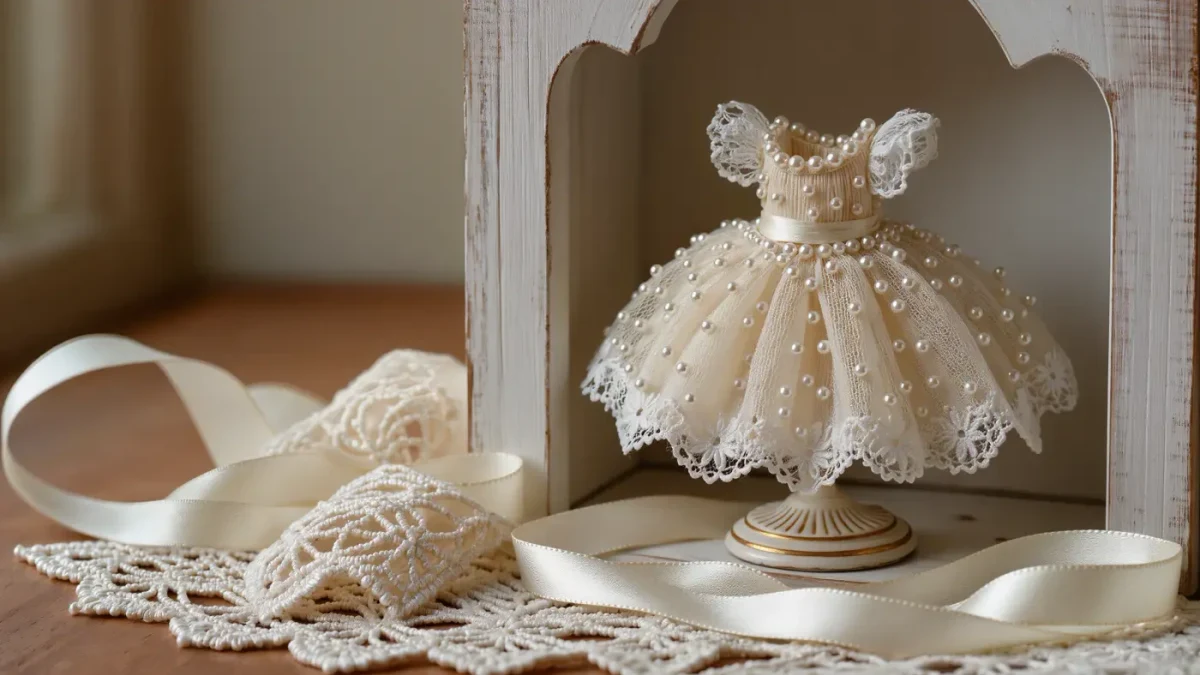
Simone Rocha designs the way a collector edits: pearls, tulle, broderie anglaise, ribbon, Aran knit and the vocabulary of christening gowns and communion dresses, gathered into collections that read simultaneously as dollhouse and as archive — and her 2021 guest collaboration for Jil Sander, announced by the house that February and shown within Sander's own minimalist collection, was the documented test that this maximal delicacy could survive translation into another designer's grammar. The daughter of the Milliner-designer John Rocha, she has built a label since 2010 whose premise is that feminine traditions are historical documents, worth rereading rather than rejecting. The result, per the Victoria and Albert Museum's and the National Museum of Ireland's collecting of her work, is a body of design treated as heritage while its designer is still in production.
Who is Simone Rocha?
The daughter of a fashion family, trained in London. Born in Dublin in 1986, Rocha is the daughter of John Rocha, the Hong Kong-born, Dublin-based designer, and studied at the National College of Art and Design in Dublin before taking the fashion MA at Central Saint Martins — where her 2010 graduate collection, per the school's records, introduced the pearl-and-tulle register that became her signature. She founded her label the same year, showed at London Fashion Week from 2011, won the British Fashion Award for New Establishment Womenswear in 2014 and the same body's Designer of the Year nomination cycle in subsequent years, per the BFC's records. The family inheritance is material as much as biographical: her father's mastery of hand-crafted, textured techniques — he showed in London for decades — gave her both the atelier culture and the example of a career built outside the capital's logic.
What are her references?
Irish, Catholic, domestic and explicitly historical. Rocha's collections draw on Aran and crochet knitwork, broderie anglaise, smocking, ribbon-work and the ceremonial dress of Irish childhood — communion and christening garments whose embroidered innocence she reworks into adult, often deliberately complicated silhouettes; she has cited the photography of the Irish studio tradition and the painters of the domestic interior in her show notes, and her dances with dancers — including long-running collaborations with choreographers — have staged the clothes in movement rather than static presentation, per the house's communications. The pearl is her master symbol: worn scattered across faces, wired into tulle, massed on hairbands, it functions as both ornament and document, a bead of inherited femininity. The critical question her work invites is whether the dollhouse reading contains a critique or merely a romance; Rocha's recorded answers, in interviews, tend toward the archive: she describes herself as collecting and reworking inherited garments and techniques, and the collections' recurring bruise-toned palettes, sheer layers and veiled faces carry the complication without editorialising it.
The Jil Sander test
The collaboration that proved the method's portability was not with a maximalist but with the house of minimalism. In February 2021, Jil Sander — under its creative directors Luke and Lucie Meier — announced a guest collaboration with Rocha within its own collection: pearl-encrusted hardware, gathered silhouettes and floral appliqué executed within Sander's reduced tailoring, presented in the house's lookbook rather than at her own show. The exercise demonstrated that her references are structural rather than decorative: pearls read as hardware, tulle as volume engineering, and the borrowed grammar of one house could be spoken in another's accent. It also placed her technique inside the industry's most austere lineage, and the collaboration's positive reception, per the trade press, confirmed her standing among the rare decorative designers whose decoration is treated as engineering.
What is Rocha's place in British-Irish fashion?
She is the documented case that a deeply referential, tradition-laden practice can be a contemporary business: a label sold internationally, stocked by the major retailers, collected by museums, shown each season in London with its own audience, and extended — into fragrance, into a Moncler Genius collaboration from 2018, into the 2021 Sander collection — without surrendering the signature. Her SS22 show at London's Courtauld Gallery and her recent seasons' engagement with dancers and portraits, per the house's announcements, deepen the archival rather than chasing novelty. Simone Rocha's dollhouse is not nostalgia; it is historiography in tulle, and the museums' collecting is the evidence that the discipline reads it that way too.
How do the shows frame the archive?
Rocha stages her collections as documents in a family album rather than looks on a runway. Models have appeared with pearl-strewn faces and veils, in clogs and ribboned hair, walking galleries — the SS22 season at London's Courtauld Gallery placed the clothes among old master paintings, per the house's announcements — and her recurring collaborations with dancers put the silhouettes in motion, testing the tulle's behaviour rather than freezing it. The scale of the business has grown around this framing: fragrance from 2019, the Moncler Genius collaboration from 2018, international stockists and museum acquisitions, all per the house's records. What keeps the practice coherent is that every extension repeats the same historiographic gesture — an inherited feminine object is collected, preserved and reworn — so that fragrance, knitwear and guest collections read as footnotes to a single, still-growing archive.
Her craft economics complete the portrait. The label's production, per the house's accounts, keeps much of the handwork in-house and with specialist workshops — crochet, smocking, pearl-wiring and embroidery that cannot be speed-sourced — which is why the collections hold their density season after season and why the guest collaborations were structurally significant: they required another house's factories to meet her handwork standards. The prices place the clothes in the accessible-luxury band rather than couture, extending the archive to a purchasing generation that museums can only display. It is a quiet repudiation of the claim that referential, hand-made design cannot be a business; the decade-and-a-half record says otherwise.
The collecting confirms the reading. Museums in Britain and Ireland have acquired Rocha's garments as contemporary design, per institutional acquisition records, placing communion-white tulle dresses and pearl-wired headpieces alongside the historical craft traditions she cites — Aran knitting, lace, embroidered christening wear. For a working designer still showing each season, this is an unusual form of peer review: the same institutions that preserve the sources are acquiring their rereading, and the dollhouse becomes a department of the archive it once miniaturised.