Launched in 1985, Calvin Klein's Obsession did something no fragrance had quite done before: it sold not a scent but a psychology, and it built that psychology across years of advertising so coherent that the word "obsession" itself became property. Photographed principally by Bruce Weber in brooding black-and-white, with later campaigns by Steven Meisel and, in 1995, a defining turn by Mario Sorrenti with Kate Moss, the campaign turned a bottle of perfume into an entire worldview — desire as identity, longing as lifestyle. Fragrance is fashion's most profitable product category, and Obsession showed how images, not juice, do the earning.
What did the Obsession campaign actually look like?
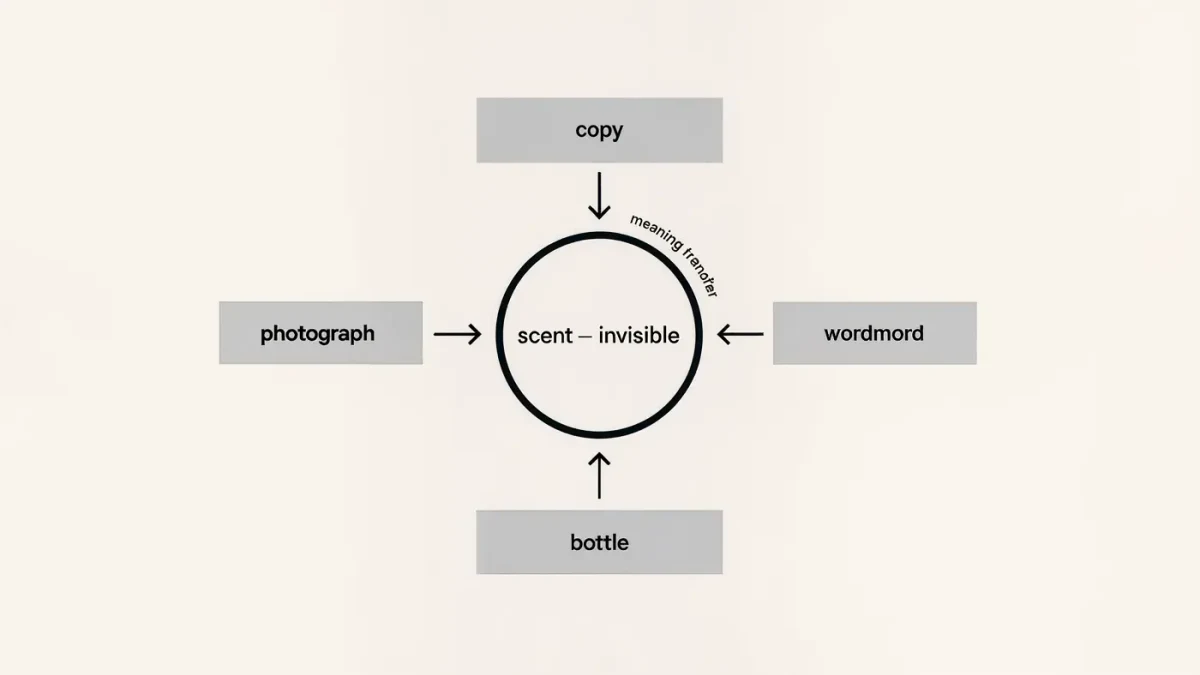
From the mid-1980s onward, the print work was unmistakable: grainy black-and-white photographs of bodies on beaches and beds, skin and water and wind, punctuated by short, intense blocks of copy about longing and loss. Weber's campaigns established the register — sensual but disciplined, erotic without explicitness, closer to art photography than to product shots of the bottle. The advertising rarely showed the product doing anything at all; it showed a state of mind the product was said to induce. This inversion — the scent as caption to the picture, rather than the picture as demonstration of the scent — was the campaign's central formal invention.
Why does fragrance need a worldview?
Because scent cannot be photographed, everything the consumer buys is made of images and words. Fragrance is also the highest-margin category in fashion: a bottle requires no fit, no size, no season, and reaches consumers who will never buy the clothes. The brand's task is therefore to manufacture desire at scale for an invisible product, and Calvin Klein understood before most competitors that the efficient way to do this was not a single advertisement but a continuous advertising environment — the same tones, the same bodies, the same vocabulary repeated across magazines and, later, television until the image became ambient. Obsession was not one campaign but a climate, sustained across a decade.
The Sorrenti turn
The most reproduced chapter arrived in 1995, when Mario Sorrenti's photographs of a young Kate Moss — shot earlier in the decade for the brand — gave the campaign its most reduced, most influential form: pale skin, damp hair, minimal type, desire stripped of gloss. The imagery was debated as widely as it was admired, which was part of its function; the controversy about Calvin Klein's advertising through the late 1980s and 1990s repeatedly returned attention to the product at no media cost. A fragrance image that people argue about is, commercially speaking, an image that is working.
What did Obsession change in the industry?
It established the template the fragrance business still uses: a named scent elevated into a named idea, a signature photographer whose style becomes inseparable from the product, and copy written with enough ambition to be read as literature rather than instruction. Competitors adopted the structure quickly — a dramatic name, an auteur photographer, a mood sustained across seasons — and the celebrity-photographer pairing became a standard unit of fragrance marketing. The deeper shift was in how a brand could assemble an image: not through any single picture but through consistency of tone, a discipline of repetition that turned advertising into something closer to an artistic practice with a media budget.
Can a campaign really constitute a worldview?
In the commercial sense, demonstrably: the images taught a generation of consumers a particular way of imagining desire, and the brand's broader Calvin Klein advertising of the same decades — minimalism, youth, controversy — drew its intensity from the same grammar. The word itself did part of the work. "Obsession" moved from psychiatric vocabulary to beauty counter, a naming strategy that borrowed gravity from the clinic and returned it as romance. That a single word can carry a product, a photographer's entire aesthetic and a decade of cultural argument is the clearest evidence that campaign direction, done at this level, is authorship — the construction of a lasting public imaginary out of commercial materials.
Why does the campaign still matter?
Because the current fragrance economy — influencer drops, mood films, celebrity scents — still runs on Obsession's founding discovery: that consumers buy images of feeling, and that the photographer, not the perfumer, decides what those feelings look like. The perfumer Jean Guichard composed the scent in 1985, and the bottle has been redesigned and reissued since, but what persisted in cultural memory was the photographic climate around it. For anyone studying how brands assemble an image, Obsession remains the foundational case: a product nobody can see, made visible — and valuable — by a decade of disciplined,authorial picture-making.
How was the campaign actually run?
The mechanics were as instructive as the pictures. A fragrance campaign of this scale ran across dozens of international magazines with strict consistency of format: the same crops, the same typographic system, the same refusal to demonstrate the product in use. Copy was written to be read rather than skimmed, a few intense sentences that gave the photographs their narrative charge, and the brand kept the visual temperature identical whether the page was in Vogue or a regional newspaper supplement. Creative direction, in this model, is less a matter of individual images than of governance — enforcing a tone across years, budgets and continents until the audience can recognise the advertiser from a single uncaptioned photograph.
What does Obsession teach a young brand?
Three durable lessons. First, name the idea, not the juice: the product's title did the strategic work before a single image was commissioned. Second, hire one visual author and let them speak — the Weber photographs are coherent in the way a body of fine-art work is coherent, and that coherence, not any single frame, built the asset. Third, sustain: the campaign's value compounded because it was kept recognisably the same while fashion around it changed. Most fragrance advertising is forgotten in a season; Obsession is remembered as a decade's emotional education, which is the difference between buying media and building an image.