The compact between modern painting and the theatre was signed in costume: when Parade premiered at the Théâtre du Châtelet in Paris on 18 May 1917, Pablo Picasso had designed its sets, its costumes and its cubist Managers — towering figures roughly ten feet tall, so bulky the dancers inside could barely move — for Serge Diaghilev's Ballets Russes, the company that over twenty seasons, from 1909 to 1929, recruited more of the era's major painters than any museum commission of the time. Fashion's recurring habit of borrowing from stage design begins here, in a wardrobe built by artists who were not decorating the dance but arguing with it.
What did Diaghilev actually ask the painters to do?
Not to illustrate, but to solve. Diaghilev — the impresario who exported Russian ballet to Paris in 1909 and kept the company at the centre of European culture until his death in 1929 — commissioned painters to design the total visual world of a ballet: curtain, scenery and costumes as a single composition in motion. Léon Bakst's designs for Scheherazade in 1910 had already flooded the Paris stage with saturated orientalist colour so persuasive that couture and interior design copied it for seasons; the experiment with the avant-garde painters went further. Diaghilev understood, as museum exhibitions of the company's designs have repeatedly argued, that a costume is a set the size of a body, and that a painter's grammar — Picasso's facets, Matisse's flattened colour — could be tailored. The company became a travelling laboratory in which the century's visual revolutions were tested at speed, before a paying public, with a libretto, a score and a rehearsal schedule.
Why did Picasso's Managers barely move?
Because they were not meant to. Parade, with music by Erik Satie, a scenario by Jean Cocteau and choreography by Léonide Massine, placed its cubist Managers — characters representing circus ringmasters, constructed as rigid sculptural costumes around ten feet high — on stage as immovable scenery that pretends to be human, the same trick cubism played on the picture: an object that asserts a body it cannot deliver. The dancers, by contrast, moved freely inside Picasso's simpler street-costume designs, so the production staged the tension of the moment: the machine figure versus the living performer. The premiere caused a scandal and a fistfight in the audience, and it changed Picasso's life twice over — it fixed his stage-design practice, which continued with Le Tricorne in 1919 and Pulcinella in 1920, and it introduced Olga Khokhlova, a dancer in the company whom he married in 1918. The enormous front cloth Picasso painted for Parade now hangs in the Musée national d'art moderne at the Centre Pompidou, a curtain promoted to painting.
What was Matisse doing on the same stage?
Solving the opposite problem. Matisse's Le Chant du rossignol, staged by Diaghilev at the Paris Opéra in February 1920 with music by Stravinsky and choreography again by Massine, asked decoration to carry drama: his designs translated the painted language of his odalisques and patterned interiors into scenery and costumes for a Chinese fable about a nightingale, an emperor and a mechanical bird. Where Picasso built obstacles, Matisse built atmosphere — colour fields and pattern that the dancers' bodies traversed like brushwork — and critics of the period treated the result as proof that a decorative painter could think in three dimensions. The two productions together set the poles that stage-and-fashion design still swings between: the costume as confrontation and the costume as environment. Others kept the laboratory open — Georges Braque, André Derain, Natalia Goncharova and Giorgio de Chirico all designed for the company before it dissolved after Diaghilev's death in 1929.
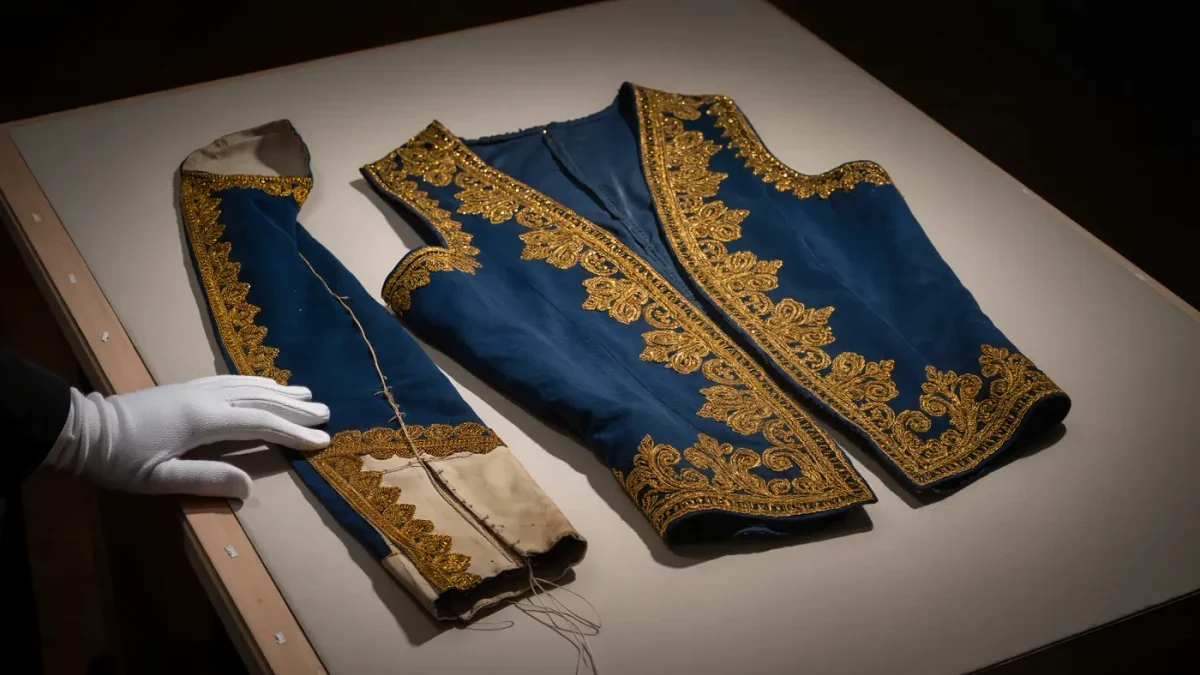
Detail mattered at the scale of stitching, too: a Ballets Russes costume had to survive lifts, gaslight and city-to-city touring, and the surviving garments, in museum collections, show reinforced seams and rebuilt bodices from constant repair — evidence that the artistic experiment rested on an unglamorous industrial base of wardrobe workshops, seamstresses and fitting schedules. The wardrobe was also a press instrument. Drawings and photographs circulated between premieres, so a costume could build a production's reputation before anyone had heard the score — the earliest dynamics of the seasonal preview, applied to ballet, with Paris as the runway.
How much of modern fashion's stagecraft comes from this?
The evidence is circumstantial but persistent, and museums draw the line carefully: the Victoria and Albert Museum, which holds one of the major collections of Ballets Russes material, treats the company as the precedent for treating a show's visual world as authorship rather than backdrop. The direct descendants are visible whenever a fashion show is built as a total environment — a set that frames the clothes as characters, a palette controlled curtain to glove, the runway conceived as a narrative rather than a walkway. The Ballets Russes demonstrated all of it first, including the commercial fallout: Bakst's colour schemes moved from the stage into Parisian couture and decoration within a season, the earliest documented case of a designer runway effect becoming a high-street trend.
What does the costume archive argue today?
That the distance between a garment and an artwork was never the point. The Ballets Russes costumes survive, in collections at the V&A and elsewhere, as objects that were at once engineering — built to survive lifts, sweat and gaslight — and manifestos, argued in cloth at the tempo of a premiere calendar. A designer who studies them is studying collaboration under pressure: the painter's hand meeting the dancer's body and the deadline, which is precisely the negotiation every fashion collection repeats.