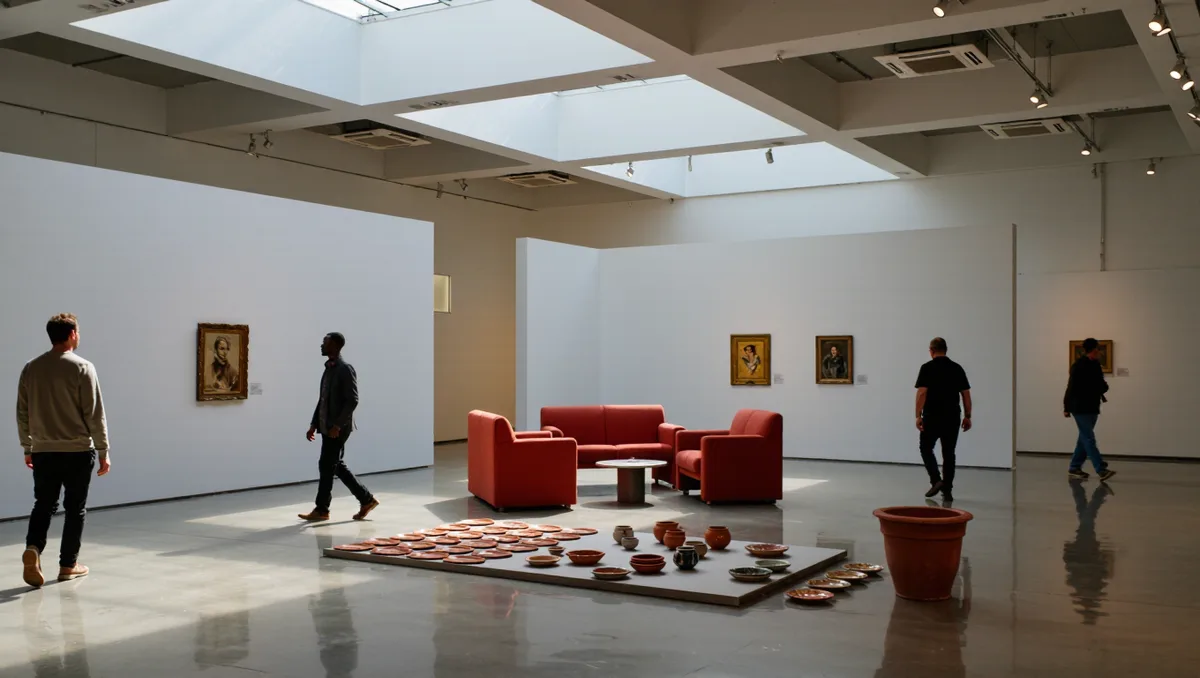
British art has rarely produced a clearer argument about dress than a vase: Grayson Perry, who accepted the Turner Prize in 2003 — presented by the poet Tom Paulin at Tate Britain, with Perry dressed as his alter ego Claire, in a frothy little-girl's dress — has built his career on vessels and tapestries that catalogue how the British reveal themselves through clothes, houses and taste. The potter who dresses the country does so with two instruments at once: the image on the object, and the persona on the body.
Who is Grayson Perry, and why ceramics?
A London-based artist, born in Chelmsford in 1960, who chose the most domestic of mediums and filled it with the least domestic content. Perry began making pottery in the early 1980s and developed a signature form — classically shaped vases, coil-built or thrown, glazed in seductive historical palettes, then covered in photographic transfers of his own drawings: scenes of child abuse, suburban violence, political fury and popular fantasy, rendered in the style of an heirloom. The dissonance is the method: a vessel associated with display cabinets carries imagery that museum walls flinch from, so that taste itself — the British instinct to sort people by their objects — becomes the subject. Works from across this career entered major collections, and the fullness of the argument was surveyed at the Whitechapel Gallery in London in 2017, in an exhibition whose title, The Most Popular Art Exhibition Ever!, was itself a joke about art's class anxieties.
Who is Claire?
His other half, in public since the 1980s. Claire is the name of Perry's cross-dressed alter ego, a persona he has refined from the confrontational appearances of his early years in the London art scene into a highly crafted figure — dresses designed with couture-level attention, often in collaboration with fashion designers and costumiers, each outfit calibrated to the occasion's class and gender codes. The Turner Prize moment of 2003, when Claire received Britain's best-known art award on national television, fixed the persona in public memory, and Perry has since treated Claire as a working tool rather than a stunt: a way of making masculinity, femininity and class performance simultaneously visible. His reasoning, repeated across interviews, documentaries and the Reith Lectures he delivered for the BBC in 2013 — the lectures' first speaker from the visual arts — is that identity is made, and that an artist should show the stitching.
What do clothes have to do with the ceramics?
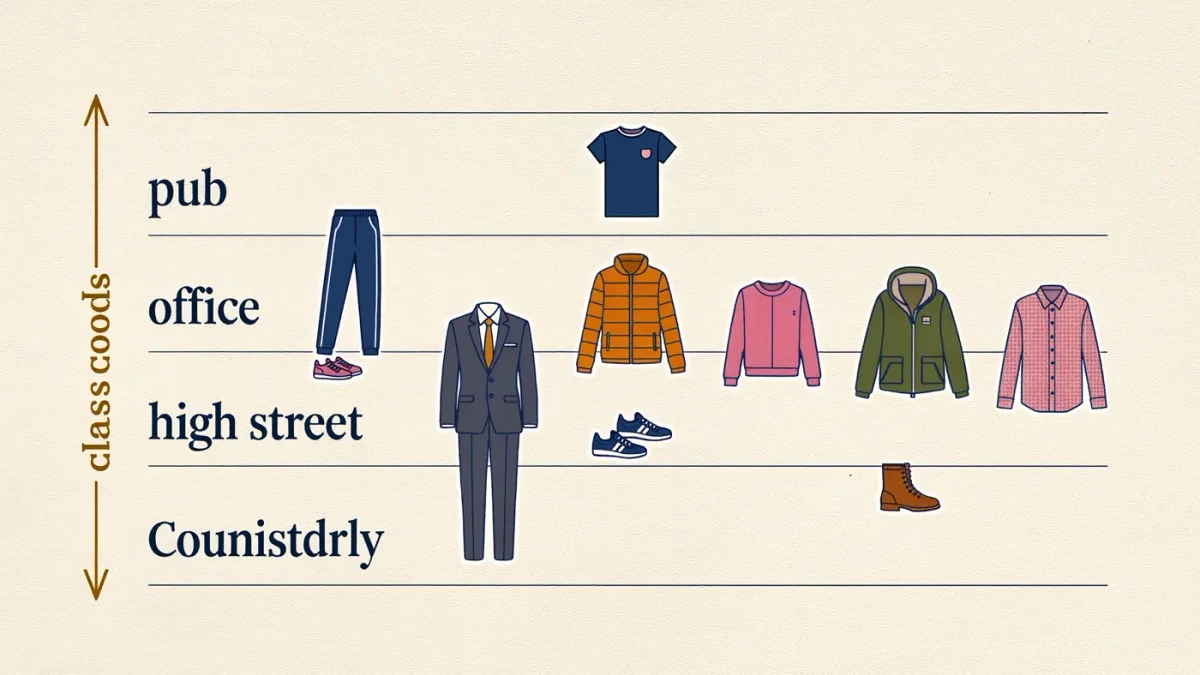
Everything, and the tapestries said so explicitly. In 2012 Perry produced The Vanity of Small Differences, a series of six tapestries — made alongside the Channel 4 documentary series All in the Best Possible Taste, in which he travelled through British class territories from Sunderland pubs to Cotswold society — that trace taste in clothing, interiors and aspiration from working class to upper class. The tapestries weave together Hogarth's moral progressions and reality-television observation: characters whose wardrobes announce them before they speak, dressing as a language everyone reads and few notice. The same taxonomy runs through the pots. For Perry, clothing is the country's largest collaborative artwork, produced daily by an entire population, and his objects simply hang it still for inspection.
The method rewards a slow look, because Perry's class observation is made from inside the codes rather than above them. He dressed for the worlds he documented — the Sunderland night out, the rural middle class, the metropolitan elite — interviewing participants about their choices before caricaturing anything, and the tapestries include the critics as well as the photographed: every panel embeds quotations from the people whose wardrobes it depicts, so the work keeps returning ownership of the reading to those being read. Fashion writers who cover class rarely get that courtesy, and fashion itself rarely extends it, which is part of why the tapestries are now cited well beyond the art pages.
Has the establishment absorbed the argument?
Substantially, and with honours. Beyond the Turner Prize, Perry was elected to the Royal Academy of Arts, received a knighthood for services to the arts, and built A House for Essex — a holiday home designed with the architecture group FAT, completed in 2015 and clad in ceramic and relief decoration covering every surface — which turned his decorative moralism into an inhabitable building. Museums now treat the vases, tapestries and Claire's wardrobe as one continuous practice about British identity, which is the fate Perry predicted: the establishment can absorb anything except irrelevance. His work remains relevant precisely because its subject, taste as class, does not date.
And the medium he chose keeps the argument honest. A pot is a vessel first and a picture second, so the class content arrives in the shape of an heirloom — the very object families use to advertise continuity — which means Perry's satire travels inside the container of respectability it examines. Fashion analysis tends to travel in essays and runway reviews; Perry proved it could travel in glazed earthenware, a dress and a six-metre tapestry, and be quoted decades later in all three forms.
Why does Perry matter to how fashion thinks?
Because he takes dress seriously as evidence rather than ornament. Fashion commentary usually reads clothing as aspiration; Perry reads it as testimony — the pub tracksuit, the Cotswold wax jacket and the couture dress each disclose the same machinery of belonging, and his ceramics force that machinery into the museum's most polite corner. For anyone who thinks about clothing for a living, the useful discomfort is his point: you are what you wear, and what you wear is a census form, filled out in public, every day.