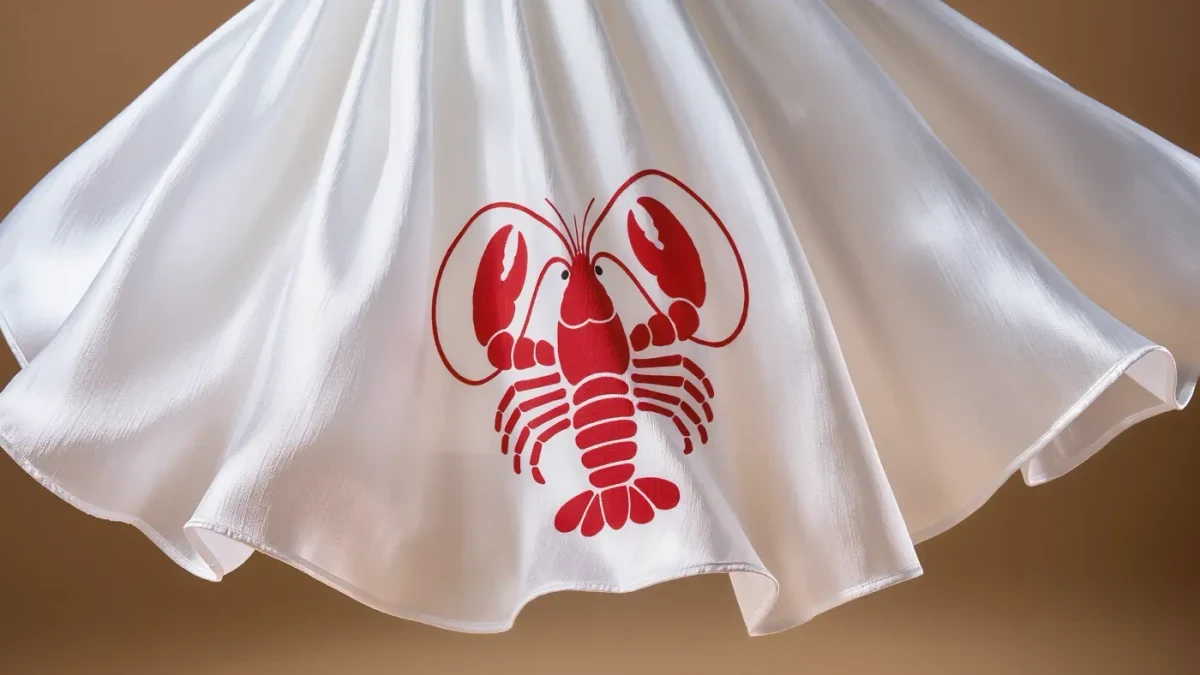
The most famous painting ever worn to dinner is a dress: Schiaparelli's 1937 lobster gown, on which Salvador Dalí placed an enormous crimson crustacean on a field of white silk organza — a sheer, crisp silk — and which Wallis Simpson wore in photographs by Cecil Beaton published in Vogue that same year. It was the high point of a two-year partnership in which the Italian couturière and the Spanish painter treated the dressed body as a picture plane, and the results remain fashion's most concrete argument that a garment can hold an idea as firmly as a canvas holds paint.
How did a couturière and a surrealist start working together?
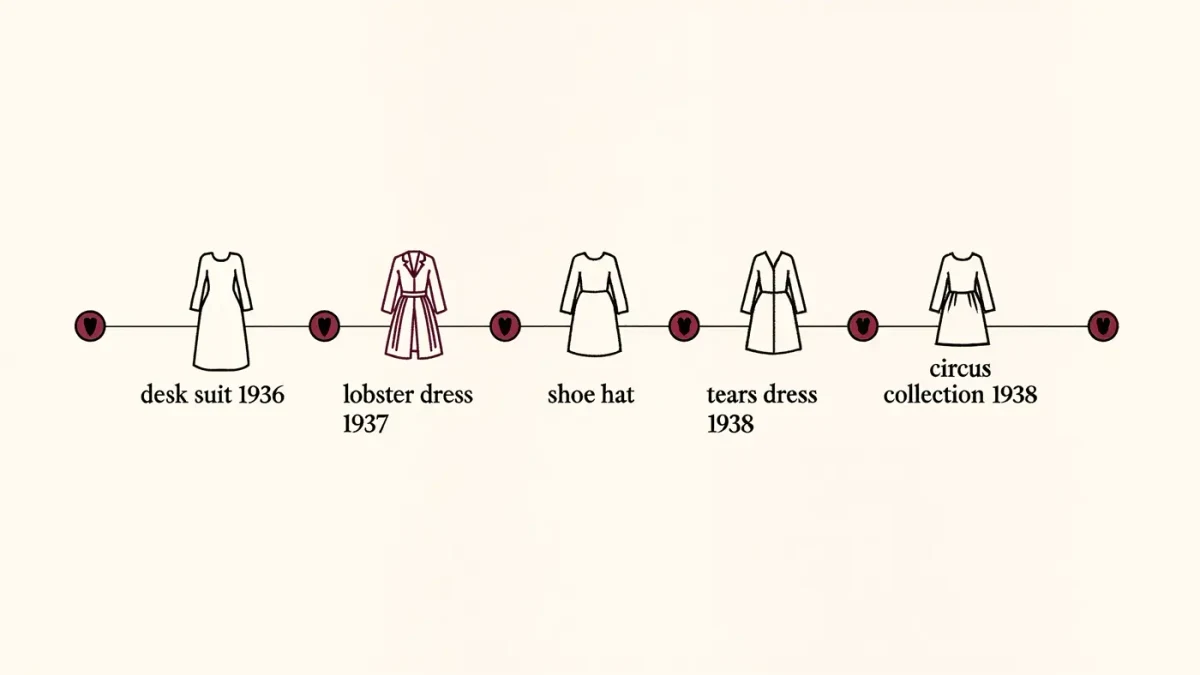
Schiaparelli had built her house at 21 Place Vendôme on wit: buttons shaped as insects, hats shaped as organs, a shade of pink she claimed as her own. Dalí, who arrived in Paris in 1929 as the sharpest tool of Surrealism — the movement that treated dreams, accidents and juxtapositions as more truthful than reason — moved in overlapping social circles, and from about 1935 the two began collaborating directly. Accounts of the partnership, including those assembled for the Metropolitan Museum of Art's 2012 exhibition Schiaparelli and Prada: Impossible Conversations, describe a genuinely reciprocal exchange: she brought him garment commissions and the discipline of the couture calendar, and he brought her dream imagery precise enough to be cut, stitched and worn. Their collaborations produced a cluster of objects between 1936 and 1938 — the desk suit with drawers for pockets, the shoe hat turned upside down onto the head, the gloves with fingernails — and, at the end, two gowns that changed the terms of the genre.
Why a lobster, and why did it work on a dress?
Because Dalí had already rehearsed the joke in another medium: his Lobster Telephone, made in 1936, had fused the crustacean — in his imagery a symbol of pleasure and of the erotic, hatched from eggs in prodigious numbers — to the most banal household object, and the dress repeated the manoeuvre on a more public stage. A lobster printed across the skirt of a white evening gown is a Surrealist displacement — the deliberate seating of one thing in the context where it does not belong — executed at couture prices. What saved it from mere provocation was Schiaparelli's sense of composition: the lobster is placed where a decorative motif would sit, low on the skirt with its tail brushing the hem, so the shock arrives as elegance. The Beaton photographs of the Duchess of Windsor in the gown, circulated by Vogue in 1937, fixed the image permanently: an aristocrat in an aphrodisiac, one of the earliest instances of a single garment becoming a circulated media event in its own right.
What did the tear dress do differently?
It replaced the joke with dread. Schiaparelli's tear dress, shown in her winter 1938 Circus collection, printed and appliquéd its pale fabric with rips — draped shreds that read simultaneously as torn skin, decayed lace and Cubist collage, an image Dalí had been developing in paintings of hanging, dissected flesh. Where the lobster dress is funny, the tear dress is morbid: it wears its own ruin as ornament, a tattered ball gown that has already been to the funeral. Historians of the collaboration, notably in the Metropolitan Museum's treatment of the partnership, read the two gowns as the range of the method — Surrealism deployed as charm, and Surrealism deployed as anxiety — and the second, darker register proved the more prophetic, arriving in Europe's last nervous summer before the war. The Circus collection itself framed both: clothes presented inside a spectacle of performance, the runway as big top, an idea fashion keeps returning to whenever it wants to argue it is entertainment.
Did the collaboration survive the decade?
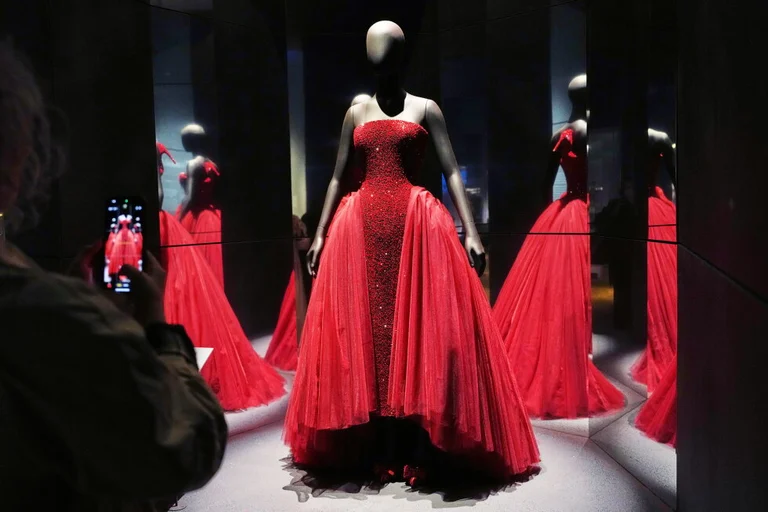
Only briefly, and not on equal terms afterward. The war closed the house's Paris operations — Schiaparelli stayed in New York through the occupation years — and when she reopened in 1945 the Surrealist moment had passed into history; the house she had built could not survive the postwar ascendance of Dior's New Look and shut in 1954. Dalí's fashion appetite cooled toward Hollywood and commerce, and the two drifted. But the record of those two years became a permanent citation: Lobster, tears, the shoe hat and the desk suit have been restaged in retrospectives at the Victoria and Albert Museum and the Metropolitan Museum of Art, and the revived house of Schiaparelli, relaunched in the 2010s, markets the collaboration's iconography — eyes, lips, gilded anatomy — as its founding visual capital. Few partnerships between an artist and a designer have left the library so thoroughly looted.
What does the collaboration argue about fashion and art?
That the border crossing works best when it is structural, not decorative. The lobster dress is not a painting reproduced on cloth, in the way a museum shop totes reproduce Van Gogh; it is a picture logic — displacement, scale, black humour — realised in the garment's own grammar of cut, placement and drape. That is why the tear dress still disturbs and the lobster still amuses: the ideas were native to the object. Schiaparelli, who wrote in her memoir Shocking Life (1954) of designing as a form of wit, understood that the dress does not illustrate the artwork; in the right hands, it competes with it.