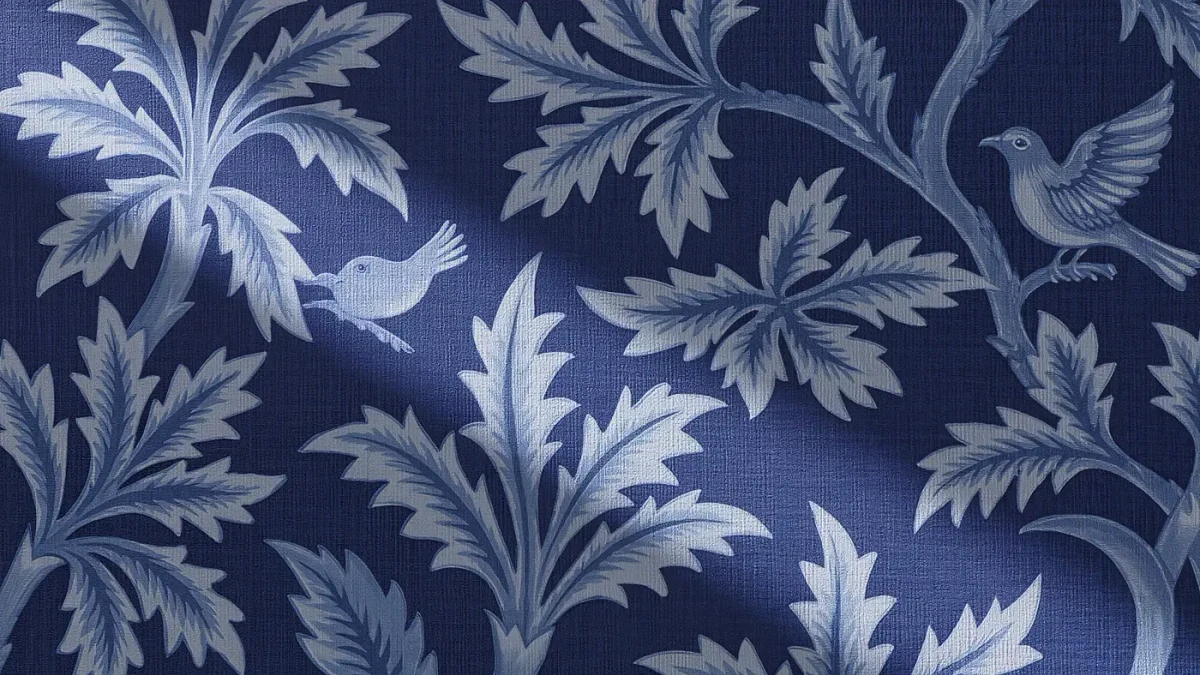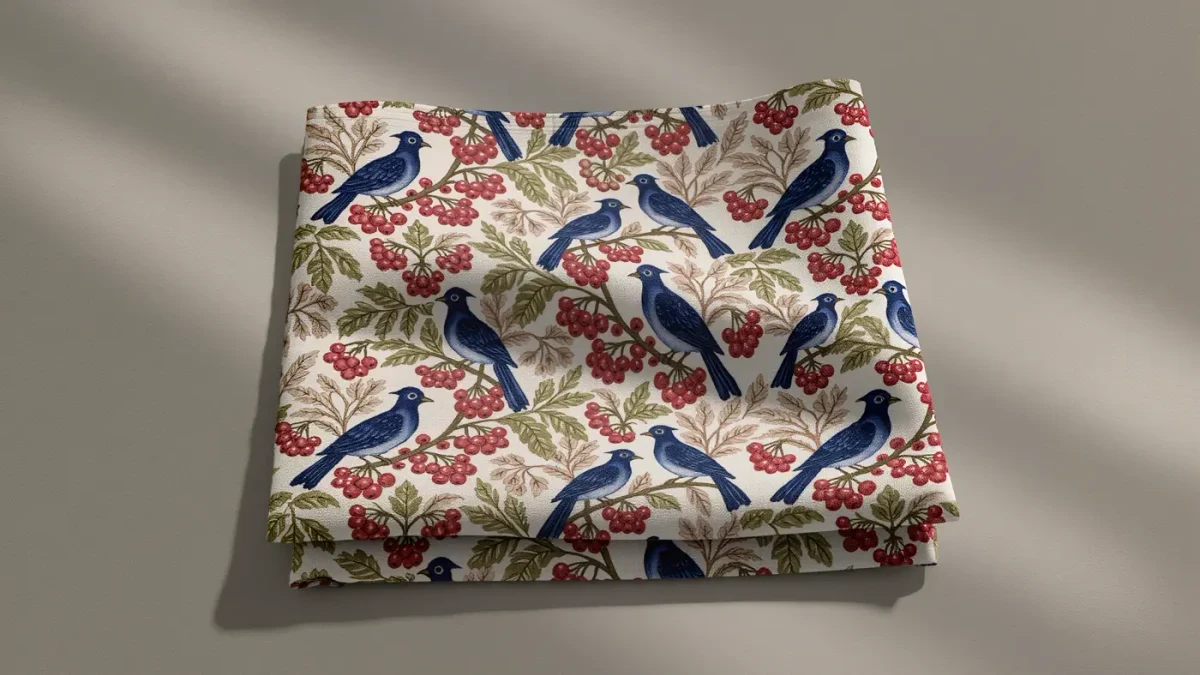
The motif fashion keeps returning to is a bird among strawberry plants, drawn in 1883: William Morris's Strawberry Thief, printed by indigo discharge — a dyeing method in which the pattern is bleached out of an indigo-saturated cloth — became one of the most reproduced textile designs of the nineteenth century and has never left circulation. Morris and the firm he founded in 1861, Morris, Marshall, Faulkner & Company, later Morris & Company, built a pattern library so structurally sound that fashion, wallpaper and interiors have been re-lending from it for over a century.
Who was William Morris, and what was he against?
A designer, poet, socialist and, above all, an argument. Morris — born in 1834, trained as an architect before turning to decoration — co-founded the firm in 1861 to reunite design with making, in revolt against the shoddy ornament churned out by industrial manufacture. The position hardened into the Arts and Crafts movement, of which he is the central figure, and into his most quoted sentence, from the 1880 lecture The Beauty of Life: “Have nothing in your houses that you do not know to be useful, or believe to be beautiful.” His patterns — Strawberry Thief, Willow Bough, Pimpernel, Acanthus — are the practical side of the politics: dense, symmetric, hand-derived repeats in which every motif is observed from nature and organized so thoroughly that the pattern reads as inevitable. He produced more than 600 designs across his career, many still manufactured today.
What makes the patterns so durable?
Engineering, first. Morris studied historic textile techniques — indigo discharge printing, natural madder and weld dyes, hand-block printing — and his repeats are built with a structuralist's care: motifs interlock so that the eye finds no original point and no exit, a density that keeps a large pattern from exhausting itself in a room or on a body. The colour discipline does the rest, since his palettes came from documented historical dye practice rather than fashion's seasonal appetite. Then there is the subject: birds, flowers and foliage, drawn from direct observation at his home Kelmscott House and the countryside around Kelmscott Manor, carry no era-specific cue. A trellis from the 1860s can sit beside contemporary tailoring without costume-drama strain, which is precisely what fashion asks of a borrowed archive.
How has fashion used the archive?
Continuously, and in two registers. The documented channel is licensing: Morris & Company's successor businesses and the Morris estate have kept the designs in legitimate manufacture for interiors since the nineteenth century, and fashion's borrowings run through the same licensing machinery, from printed-cotton collaborations with heritage mills to runway garments that quote the repeats directly. The other register is influence, harder to attribute by name and honestly stated as lineage rather than citation: the botanical repeat, the natural-dye palette and the doctrine that pattern must be structural, not applied, run from Morris through twentieth-century printed fashion into today's sustainable-textile discourse. Fashion journalism reaches for his name whenever craft printing returns — which is often, because the questions he raised about machine production, labour and beauty are the same questions the industry now files under sustainability.
One episode shows how the borrowing actually behaves in practice. When heritage brands and high-street retailers print Morris repeats, the licence routes through the archive's custodians, and the resulting garments rarely alter more than scale and ground — because the repeat cannot be casually redrawn without losing the interlock that makes it work. A pattern that took Morris months of drawing and repeated dye trials resists the seasonal redesign cycle by construction, which is why borrowed Morris reads as heritage on a runway and as homage on a T-shirt, and why the designs have survived ownership changes, taste cycles and two fashion centuries with their authority intact.
Would Morris have approved of the borrowings?
Probably not of the system, and the tension is worth keeping. A socialist who lectured against art made for the idle rich would have regarded a status handbag licensing Strawberry Thief with some irony, and museum treatments of his work — the Victoria and Albert Museum holds one of the largest Morris collections — do not soften the politics. Yet the patterns themselves have survived every ideological weather because they were built to outlast it: his stated method was to make goods that people would keep rather than discard, and a motif that remains desirable in 2026 is the argument winning by other means. The borrowing fashion performs is, in a narrow sense, exactly the immortality he engineered.
The secondary market for the designs tells the same story from another direction. Nineteenth-century Morris yardage and early twentieth-century productions appear continuously in museum collections and design sales, catalogued with the care given to furniture rather than to fabric, and the V&A's Morris holdings function as the reference archive against which modern printings are checked for colour and repeat accuracy. An archive consulted that seriously by living manufacturers is not a museum of dead styles; it is closer to a working standard, which is the position fashion's borrowings occupy whether or not the borrowings acknowledge it.
What should a viewer look for in a Morris print?
The reversals and the discipline. In Strawberry Thief, trace how the thieving birds, the strawberry plants and the butterflies occupy alternating registers of figure and ground, so the eye never settles; in Willow Bough, count how few elements make the pattern, and how the spacing does the work. Then look at what fashion adds when it borrows — usually scale and ground colour, rarely structure — and the reason for the archive's longevity becomes visible: Morris built patterns the way engineers build bridges, and the borrowings are traffic.