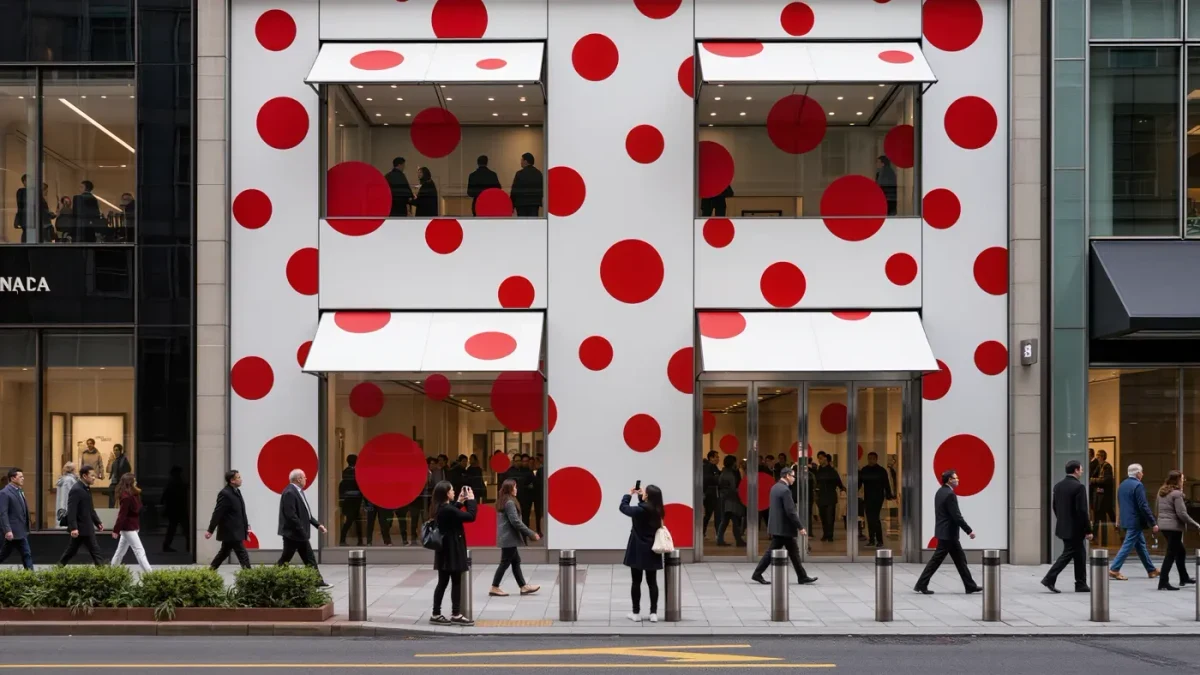
Few motifs in contemporary art have a résumé as long as the polka dot of Yayoi Kusama: she had already spent a decade in New York, showing her Infinity Net paintings in her first solo exhibition there in 1959 and staging body-painting happenings on the streets in the late 1960s, before the pattern reached its commercial summit in 2012, when Louis Vuitton — under artistic director Marc Jacobs — covered its Fifth Avenue flagship and a collection of bags, accessories and ready-to-wear in her dots. The distance between those two events is the story of how a personal obsession became a public language.
Where did the dots begin?
In childhood, according to the artist's own account, which she has repeated consistently across decades of interviews and her autobiography: hallucinations of nets and dots that overlay her perception since youth, and which she has described as the origin of her imagery. Kusama, born in Matsumoto, Japan, in 1929, moved to New York in 1958, and the early works there — the Infinity Nets, near-monochrome canvases whose looping arcs of paint accumulate into fields that seem to continue past the frame — made repetition itself the subject. A line she has returned to in her writing captures the claim: that our earth is only one polka dot among a million stars. The dot, in other words, was never decorative; it was cosmological, a unit of measure for infinity, and the nets were the dot's gradual conquest of the picture plane.
What happened in the 1960s New York years?
Escalation, in public. Kusama's first New York solo show of Infinity Nets opened at the Brata Gallery in 1959; by the mid-1960s she had moved the accumulation into space with mirrored environments — the Infinity Mirror Room, in which lights multiply into an endless field — and then into performance, organising happenings — unscripted public art events — in which participants, their skin covered in painted polka dots, appeared in settings from the Brooklyn Bridge to Central Park, frequently as anti-war protest around 1968. The happenings made her a media figure and a countercultural one: naked, painted and relentless, she fused Pop's image logic with performance art's body and the era's politics. Fashion was present from the start — she designed and sold dotted garments and furnishings through her own enterprise in those years, an early experiment in the art-market merchandise that would later be called merch, decades before the term.
Why did she leave New York, and what came back?
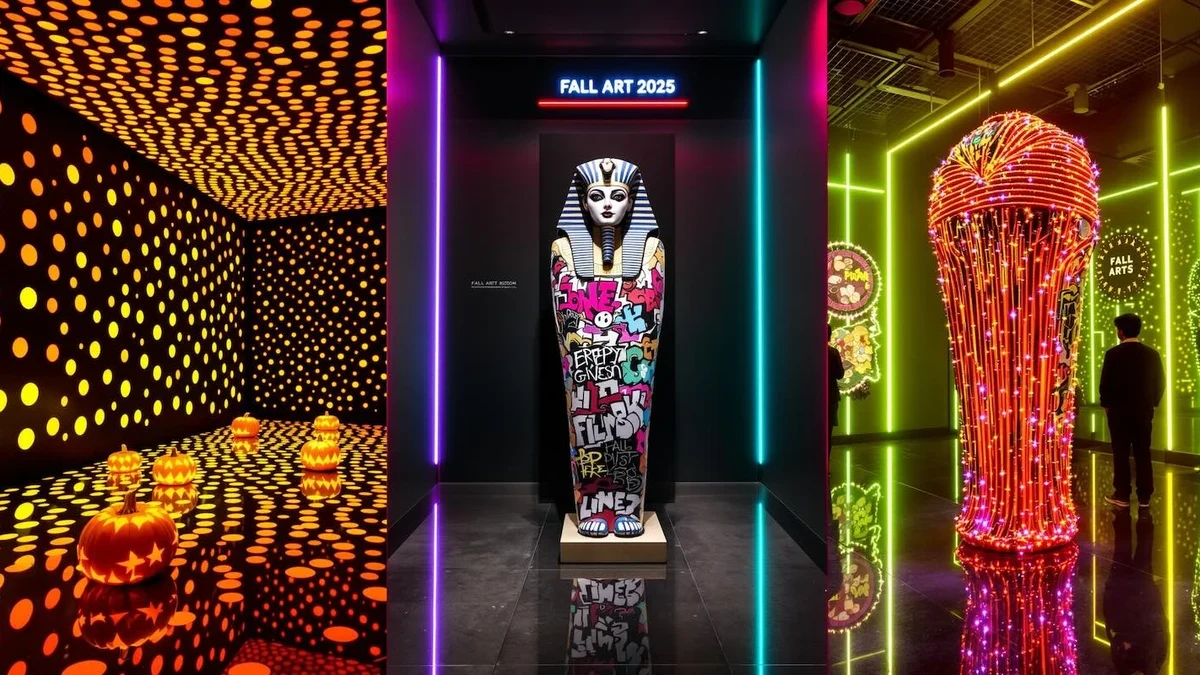
Exhaustion and illness, largely. Kusama returned to Japan in 1973, and from 1977 has lived by choice in a psychiatric hospital in Tokyo, with a studio nearby, a fact she has spoken about openly and that frames the work's discipline: art as daily regimen. The art world's rediscovery came in the late 1980s and 1990s — she represented Japan at the Venice Biennale in 1993 with a mirrored room filled with dotted pumpkins, and retrospectives followed, including a major traveling survey in 2012. By the time Louis Vuitton arrived, the comeback was complete: a reclusive artist in her eighties, working daily in Tokyo, had become one of the most recognised figures in contemporary art, her dots functioning as a signature legible from a moving car.
The economics of that recognition deserve their own paragraph. What was once hand-painted at the edges of the art market became, by the 2010s, a licensing architecture of museum retrospectives, mirrored-room ticketing phenomena and product collaboration, and the Tokyo studio remained the single point of authorship from which all of it radiated. The 2012 partnership with Louis Vuitton did not invent this model — but it proved the model could hold at the highest price point in fashion without the work losing its unsettling density, because the dots on a monogrammed bag still read, on second look, as compulsion rather than cheer.
What did the 2012 Louis Vuitton collaboration actually involve?
Depth, not just a logo swap. The collaboration, developed with Marc Jacobs, whose own Spring 2012 show for the house had already used a dotted set, produced a capsule collection launched in July 2012 — bags, small leather goods, ready-to-wear and accessories in varied dot treatments, from enameled raised dots to wave-like patterns drawn from her canvases — and store interventions, most famously the Fifth Avenue flagship wrapped in a Giant Balloon figure of Kusama herself, a mannequin-scale effigy dotted head to toe. Crucially, the campaign treated the artist as author: film portraits of Kusama at work in her Tokyo studio ran alongside the product imagery, and the imagery retained her vocabulary of accumulation rather than simply placing dots on bags. A second, larger collaboration followed in 2023, confirming the 2012 experiment as a template for the artist-luxury partnerships that have become standard practice.
A narrower observation completes the picture: the collaboration's imagery consistently credited the work, not just the name. Photographs of the artist's hands at the canvas, films of the studio routine, captions that named the canvases from which each dot treatment was drawn — these choices treated the luxury consumer as a viewer first, and they are the reason the 2012 collection is still cited as the reference case rather than the cautionary tale.
Does the luxury context betray the counterculture?
The tension is real, and Kusama has never pretended otherwise — she sold hand-painted dotted goods on the street in the 1960s, and has written of her ambition to be wealthy and famous with disarming candor. What the 2012 collaboration preserved, arguably, was the dot's ambiguity: a pattern that reads as joy from a distance and as compulsion up close, in which repetition becomes both pleasure and engulfment. A bag in the collaboration carries both readings at once, which is more than most artist merch can claim.